I run a staffing company, not an engineering team. But since January I've had AI in pretty much everything I do, and somewhere along the way I realized I am now working in the same way software developers do. Instructions in files. Rules for what the AI may and may not claim. Executing tasks in sessions. Et cetera.
My prediction is: all digital and knowledge work will be increasingly organized like the work of a software engineer. And interestingly, a lot of research is being done into how AI affects the software development profession. So if you want to know what your work will look like in the near future, keep an eye on what happens in software teams.
What developers found out
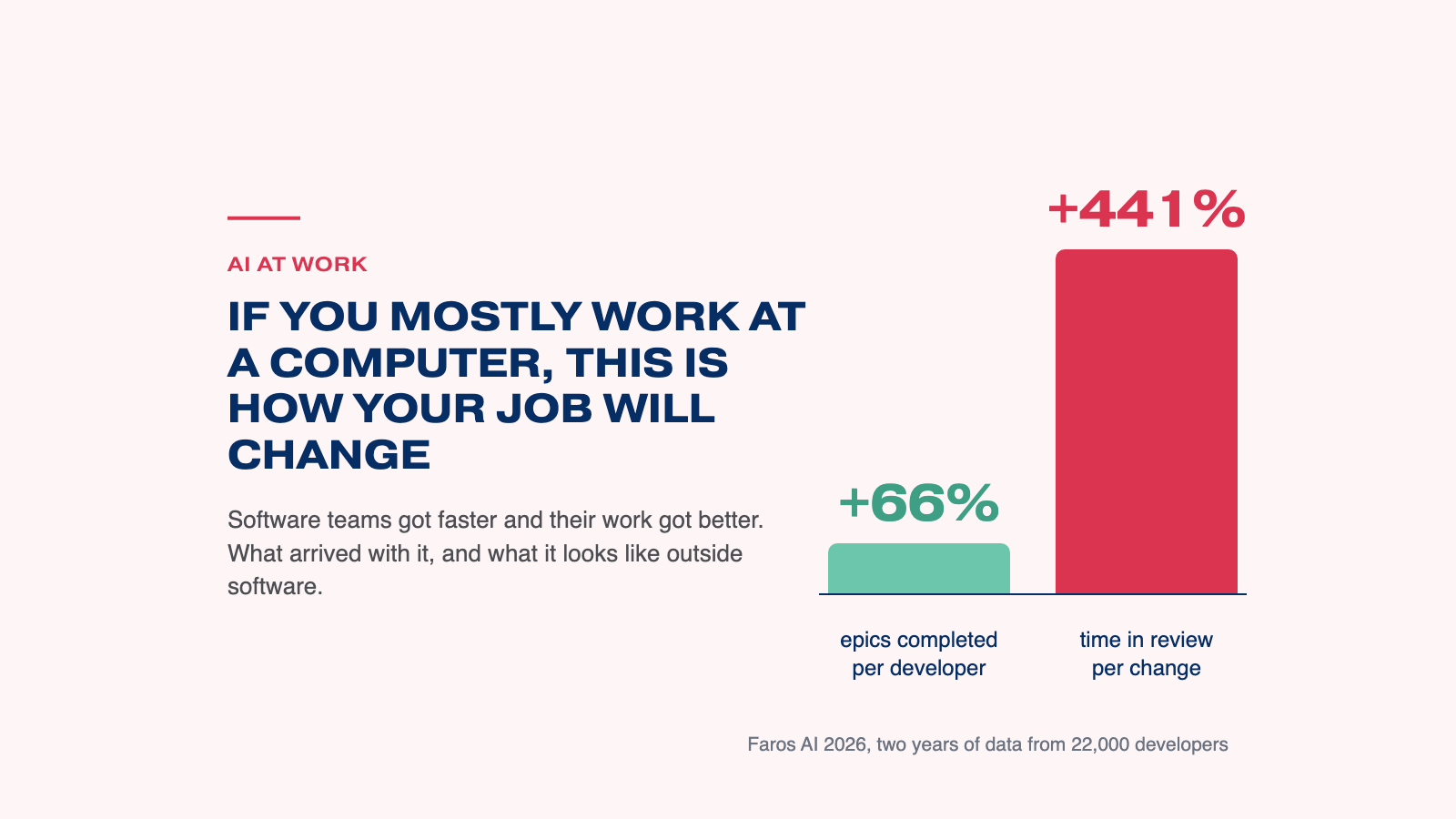
Firstly, software developers are more productive and their work got more interesting. Faros AI looked at two years of data from 22,000 developers. Teams complete 66% more epics per developer. Developers like it, too: in GitHub's own 2022 survey, 60 to 75% say they feel less frustrated and get to focus on more satisfying work.
The same Faros data also shows new challenges this way of working brings. Median time a change spends in review is up 441%. Bugs per developer up 54%. Incidents per change up 243%. And in Stack Overflow's survey of 49,000 developers, the number one frustration, named by 45%, is "AI solutions that are almost right, but not quite". Two thirds say they now spend more time fixing almost-right code.
In short: Faster, more fun, and a new kind of work: finding out which part of "almost right" isn't. Developers have had about a year of dealing with those new challenges, and it is interesting to see what they came up with.
Dealing with new challenges
Simply put, it means a lot more checks and balances:
- Don't trust green tests.
- Prove it works before you say it works: the more disciplined setups now demand a screenshot or a measurement before an AI agent may call a feature done.
- Some developers have one model review what another model wrote.
The key skill is "being able to confidently instruct them on how to make changes and then confidently verify that those changes have been applied in the correct way" (Simon Willison, prominent AI developer). Sometimes that means reading every line, but most of the time it doesn't.
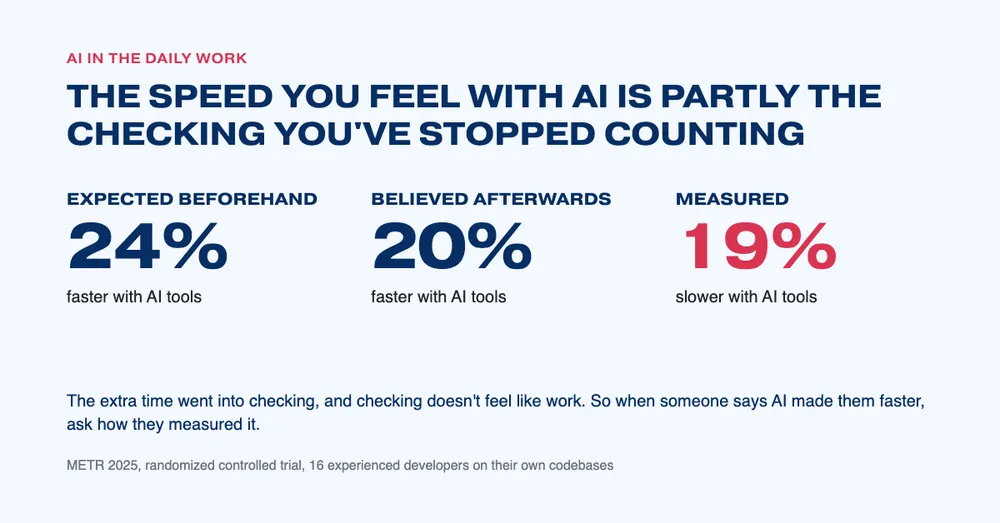
There's a catch. In a 2025 randomized controlled trial, METR found that 16 experienced developers, working on codebases they knew well, were 19% slower with AI tools. They had expected to be 24% faster. Afterwards, they still believed they had been 20% faster. Now in 2026 I would expect this to have improved, but it points to something interesting: the checking feels like background rather than work, which is why nobody books it as time.
If developers can't feel where their day went, I probably can't either. So I went back over last week.
Last week, outside software
The annual accounts came back from our accountant. My AI had prepared the reply, and it was about to tell him he was looking at the wrong version of the document. He wasn't. The AI's own read of the PDF had silently dropped three sentences. I caught it because the accusation didn't fit the man, not because I re-read the accounts.
A set of notarial deeds. The AI read one deed on its own and concluded a loan was still outstanding. The settlement agreement in the same set cancelled it. One question fixed it: "what else in here could be wrong?"
A forecast question from our CFO. The AI had a plausible explanation for a difference between two versions of the numbers. Plausible, except the mechanism it named could only have pushed the numbers the other way. One logic question from me, and the real cause turned out to be a project that had dropped out of a dashboard.
None of these took long. All three would have gone out wrong if I hadn't looked. And every one of them was faster and better than it would have been in 2025. Making things has mostly left my desk. Checking whether they're right has taken its place.
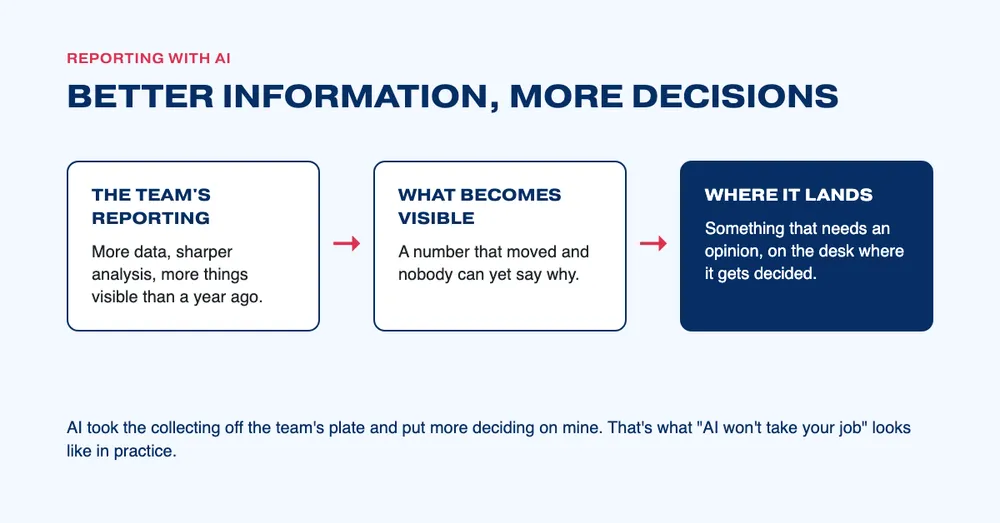
It's not only my own AI. Our monthly management updates have become much better since the team uses AI to collect and present the numbers. More data, sharper analysis, more things visible. Great. It also means more things I need to have an opinion about. Better information in the team turns into more decisions on my desk. I think that's what "AI won't take your job" looks like in practice: AI took the collecting off the team's plate and put more deciding on mine.
So: more on my desk, and it doesn't feel like work while it's happening. What do you do with that?
What I do about it
I don't have the complete answer. This is what works for me so far.
I don't read everything. My brain doesn't work that way anyway; I look for patterns and for things that don't fit. An accusation that doesn't match the person, or a cause that points the wrong way. The developers' rule about not reading every line is the same instinct: verify the risky parts, not all of it.
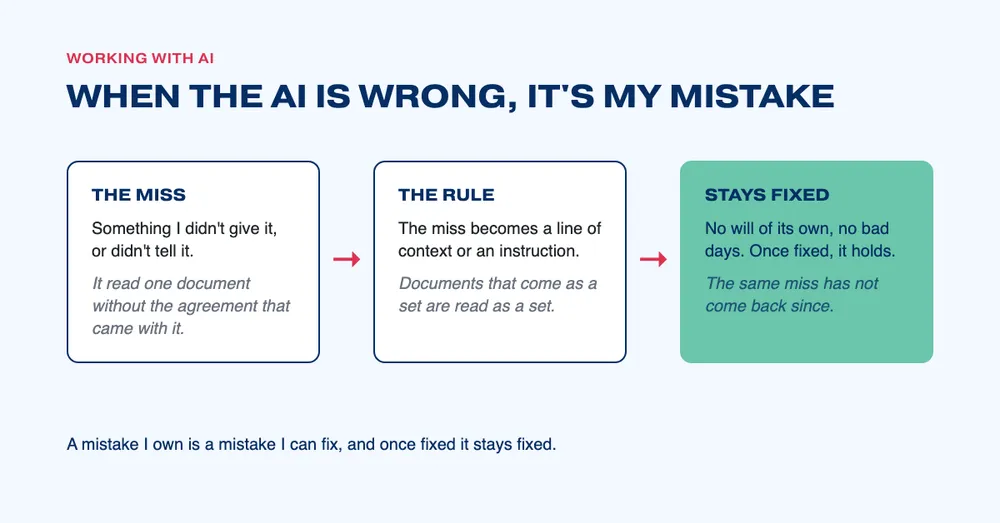
And every miss goes into the system. When the AI read one deed without the other, that became a rule: documents that come as a set are read as a set. When it explained a number difference without reconciling the two versions first, that became a step. By now most of my working rules for AI started as a mistake it made once.
That's where this hassle differs from the old one. An AI has no will of its own and no bad days. You can't hold it accountable the way you would a colleague, and there's no point trying. When it's wrong, it's my mistake: something I didn't give it, or didn't tell it. That sounds like a burden. In practice it's a relief. A mistake I own is a mistake I can fix, and once fixed it stays fixed. I get to shape the thing to how I work, in a way you can't with a person and wouldn't want to.
More on my desk, and better
So yes, there's more on my plate than in January. It's judgment instead of execution, and I'll take that trade every day. I get more done and the work is more interesting. Yes, there is real hassle, but it's the kind that shrinks a little every week (and then is replaced by new hassle haha).
There's one pitfall: to take on work that does not belong with me in the first place. It can be tempting, and the AI always tries to move things forward. It prepares everything, so whatever it puts in front of me looks like my work, whether it is or not. But as I wrote in a comment last week: the best fix for me isn't a better process. It's a process I'm not in.