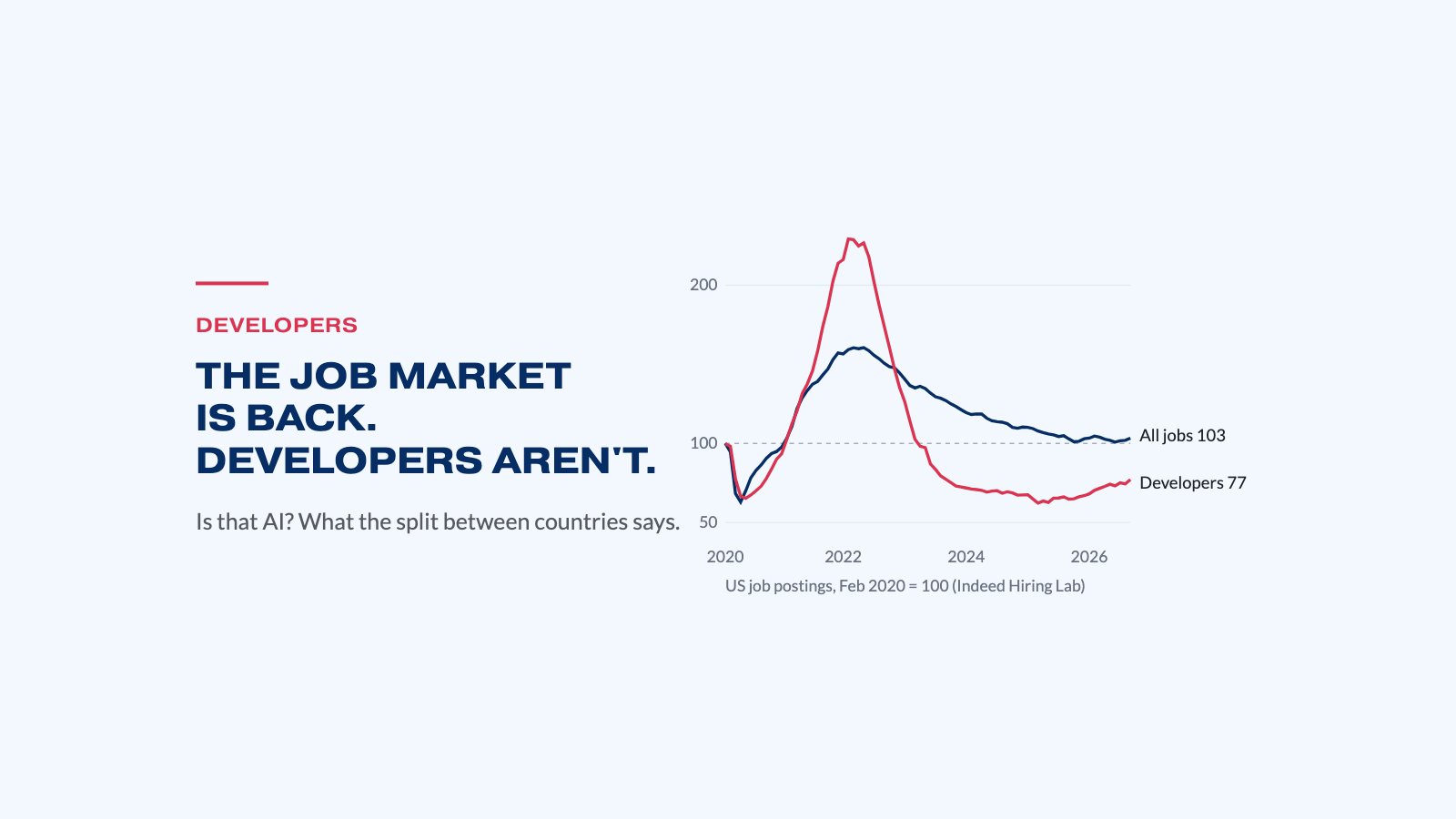
I like to think of myself as a numbers guy. So it's a little embarrassing that it took me until this week to put two lines I check every month next to each other: job postings for developers, and job postings for everything else. One of them is back where it was before the pandemic. The other isn't even close.
In March I wrote a whole article about developer vacancies and still missed it. And it changes my answer to the question I worry about most: is AI making developers, and with them a company like ours, less needed?
The gap
Indeed's Hiring Lab tracks job postings per country, with February 2020 as 100. In most countries, all job postings together are back at or above that level: 103 in the US, 105 in Germany, 114 in the Netherlands.
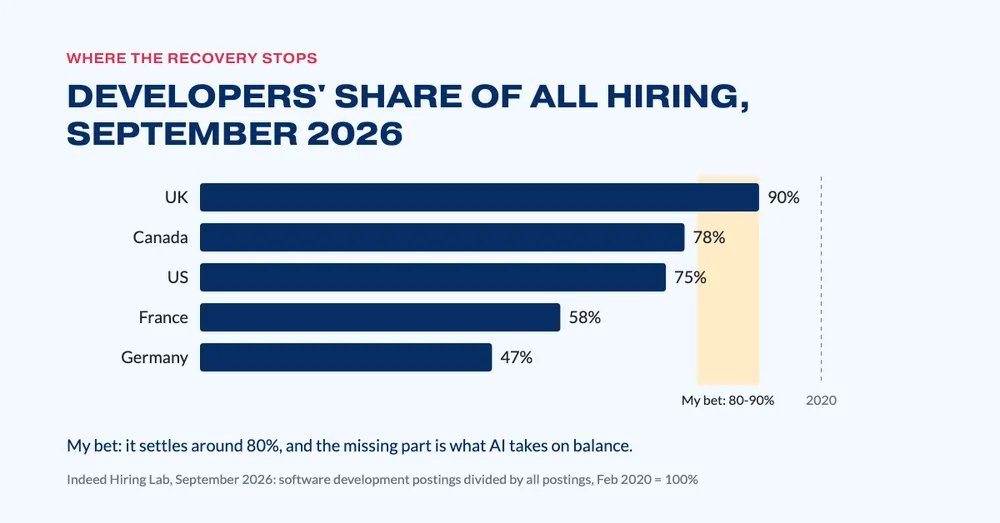
Developers haven't come back with them. Divide developer postings by all postings and you get developers' share of all hiring. Against 2020, that share now stands at:
- UK: 90% (flattered by a UK job market that is itself still far below 2020)
- Canada: 78%
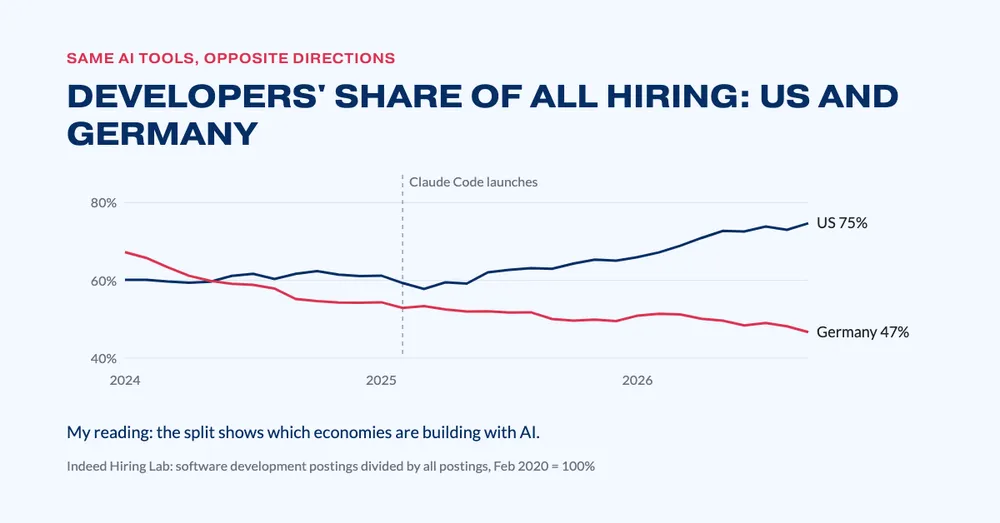
- US: 75%
- France: 58%
- Germany: 47%
In the US, France and Germany, a quarter to more than half of the demand for developers hasn't come back with the rest of the job market.
Is that AI?
In most countries the gap opened at the end of 2022. That is when ChatGPT came out, and it's also when the big tech layoffs started. From these numbers alone you can't tell the two apart.
What helps is what happened next. Since the start of 2025, developers' share has gone from 61% to 75% in the US and fallen further in Germany, from 54% to 47%. AI tools are available in every country at the same time. If AI were steadily pushing down the demand for developers, the gap would be widening everywhere. Instead it's closing in one country and widening in another.
Part of the explanation is the cycle. In every country, developer postings fell deeper than the job market as a whole after 2022, in the US and Germany almost twice as deep. In the English-speaking countries they had also risen much further in the boom before it. So in this cycle at least, developer hiring swung harder than hiring in general.
The other part is more interesting. Indeed's own economists noticed that US developer postings started to rise almost exactly when Claude Code and other agentic coding tools came out, in February 2025: up almost 15% in the 16 months after, while all US postings fell 7%. Of the increase between May 2025 and May 2026, 37% came from jobs with AI in the title (Indeed Hiring Lab, July 2026). So in the US, AI seems to be creating developer work as well as taking it.
My reading: the split between countries shows which economies are building with AI. The US is, and its demand for developers is coming back. Germany and France much less so far: in France developers' share is flat, in Germany it is still falling.
So to my own question: for now, mostly no. What is happening to developer demand is mostly a deep cycle, and where companies build with AI, it seems to create developer work as well as take it.
Where it's going
If AI takes a share everywhere, every country's recovery should stop at about the same level. The US and Canada are the best places to look, because their job markets as a whole are back at their 2020 level. Canada has been stuck between 78% and 80% since mid-2025. The US climbed fast in the first half of this year and has barely moved since the summer, at 75%.
My bet is that in the countries that recover, developers' share settles somewhere around 80% of what it was in 2020, and no higher than 90%. The last 10 to 20% is the part I'd put down to AI on balance: it creates new developer work, but companies that grow need fewer developers to do it than they used to.
In the Netherlands the gap is still open. Indeed has no developer index for the Netherlands, but our estimate, based on the countries that do have one, is still going down, and puts developers' share most likely at a little over 70% of 2020. That estimate leans on other countries, though, and the Netherlands is neither the US nor Germany.
My impression is that Europe has largely lost the AI race, apart from hardware like ASML. But the Netherlands escapes that more than most. Its job market as a whole is the strongest in this set, though it moves with the rest of Europe and is still 8% down on a year ago. Either way, it has room to grow: getting to 80 to 90% would mean 10 to 25% more developer vacancies at today's job market, and more once the market as a whole turns.
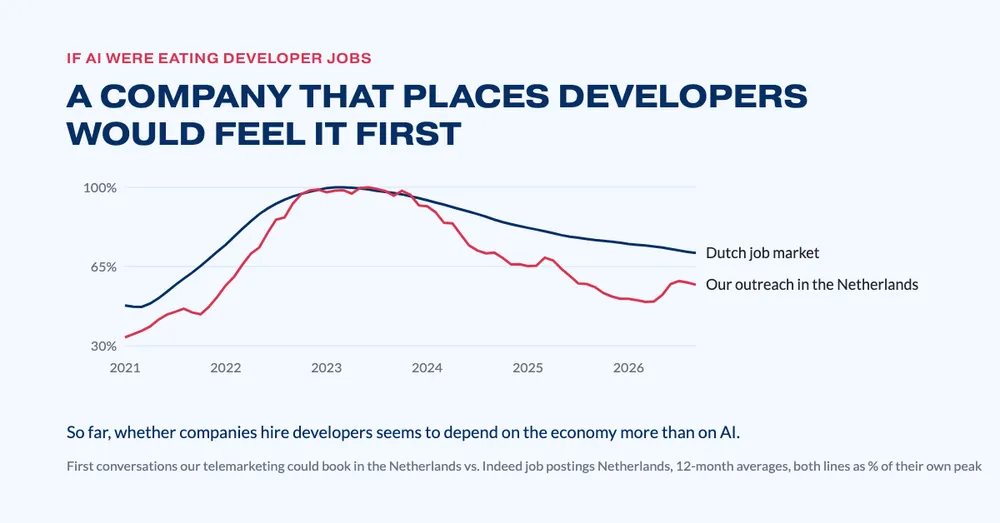
Our own telemarketing points the same way. We closely monitor job postings to find the companies we call, so if AI were eating the demand for developers, we'd be among the first to notice. Instead, the number of first conversations our telemarketing could book has tracked the Dutch job market as a whole, month by month since 2020, more closely than any developer index. That Dutch market has been flat since July. At the 2022 peak it followed the American job market within a few months, and the American market turned in June, so I expect the Netherlands to turn in the first half of 2027.
I'm wrong in one direction if developers' share in the US is above 90% by the end of 2027, because then AI takes less than I think. I'm wrong in the other direction if it starts falling again while the American job market keeps growing, because then AI is doing more than I think.
What it means if your business depends on developers
In March my answer was that this isn't about AI. Today I'd say it's mostly the cycle and how much an economy builds with AI, plus a smaller part that AI takes for good.
If you hire developers, or sell to companies that do, the bigger question for the coming year is when your own economy turns, and whether companies in it start building with AI the way American companies do. Plan for a market for developers that comes back with the economy, 10 to 20% smaller than it was. What I don't know yet is whether AI's share stays at 10 to 20%, or keeps growing as the tools get better.