On 27 October, credit insurer Allianz Trade published its insolvency outlook: bankruptcies are rising worldwide for the fifth year in a row, and this year the report has a section on AI. Its warning is that in smaller countries such as Belgium and Sweden, companies that don't adopt AI "are starting to pay the price".
For anyone running a small company that hasn't figured out AI yet, that is an uncomfortable sentence. So imagine my surprise when I read the report and found that its own test shows no link between AI use and bankruptcies!
What Allianz actually measured
Allianz compared the share of companies using AI with the bankruptcy trend in 9 sectors across 8 European countries, 66 combinations for which it had data. Across all of them, the correlation is, in its own words, "essentially zero". The report itself names interest rates, energy costs and the state of each sector as what drives bankruptcies.
The warning rests on those two countries, where the most digitised sectors are doing worst. That is 8 sectors in one country and 6 in the other, too few to rule out chance. And because AI use is measured per sector, the data can't show whether the companies that failed were the ones without AI.
So for now, there is no sign that how much AI a sector uses predicts how many of its companies go under. That doesn't mean there is no gap.
I think the real AI gap runs between big and small companies.
The gap by company size
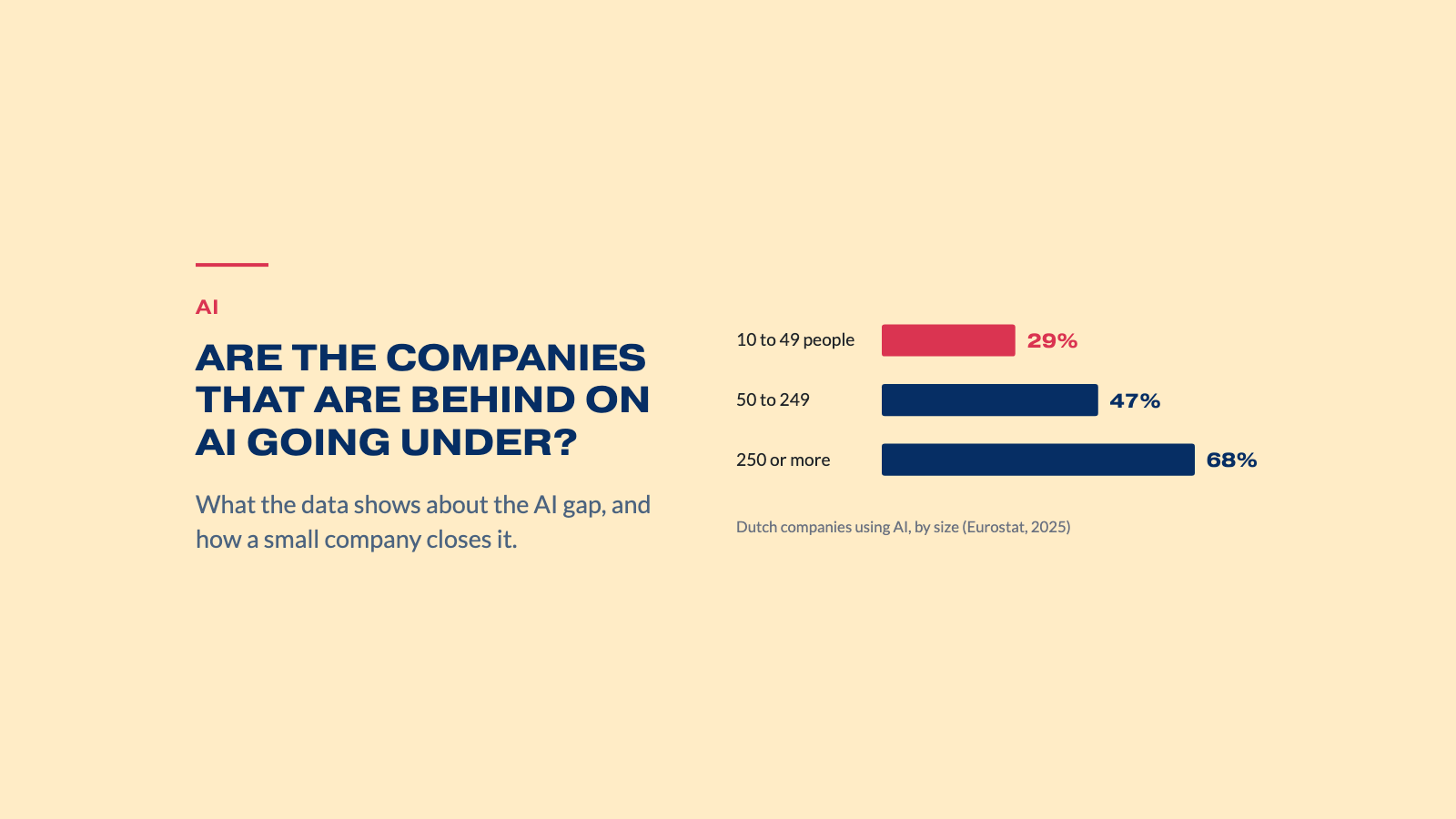
Share of Dutch companies with 10 or more people that use AI (Eurostat, 2025):
- 10 to 49 people: 29%
- 50 to 249 people: 47%
- 250 or more: 68%
And using AI pays off very differently. In a study of more than 12,000 companies in the EU and the US, published in January, economists of the European Investment Bank and the Bank for International Settlements measured what adopting AI does to turnover per employee, with a method designed to isolate the effect of AI itself. On average it adds 4%. For large companies it is close to 8%, for medium-sized ones 4%, and for small companies the study finds no measurable gain.
Large companies are already getting more out of AI, while small companies so far get nothing measurable from it.
What's holding small companies back
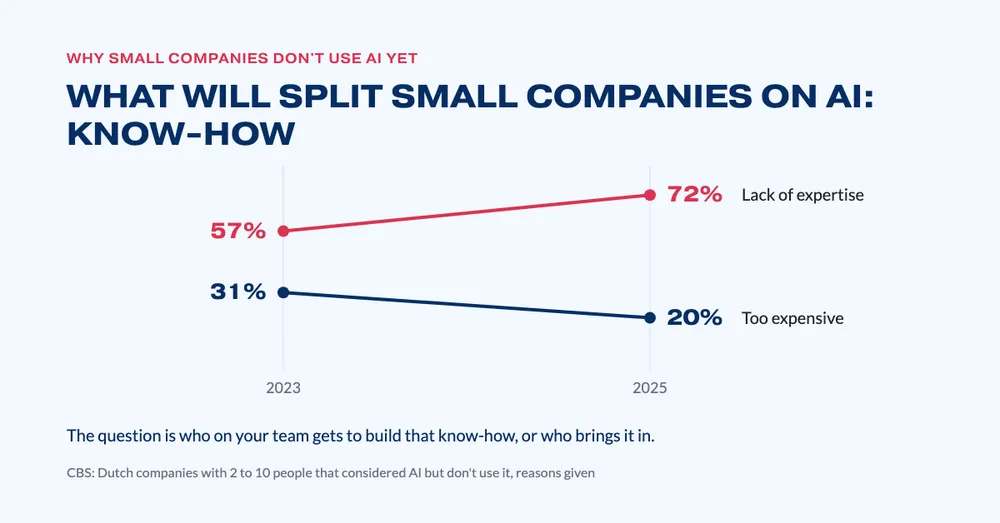
You'd expect money to be the main obstacle, but it is becoming less of one. CBS asked Dutch micro companies (2 to 10 people) that had considered AI why they didn't use it:
- lack of expertise: 56.5% in 2023, 71.6% in 2025
- too expensive: 30.9% in 2023, 20.3% in 2025
For small companies, knowing how to use AI is by far the biggest obstacle, and it has grown since 2023.
At Tunga, we talk to a lot of entrepreneurs, and AI comes up in more and more of those conversations. The ones who are furthest along hardly talk about tools. They talk about their people:
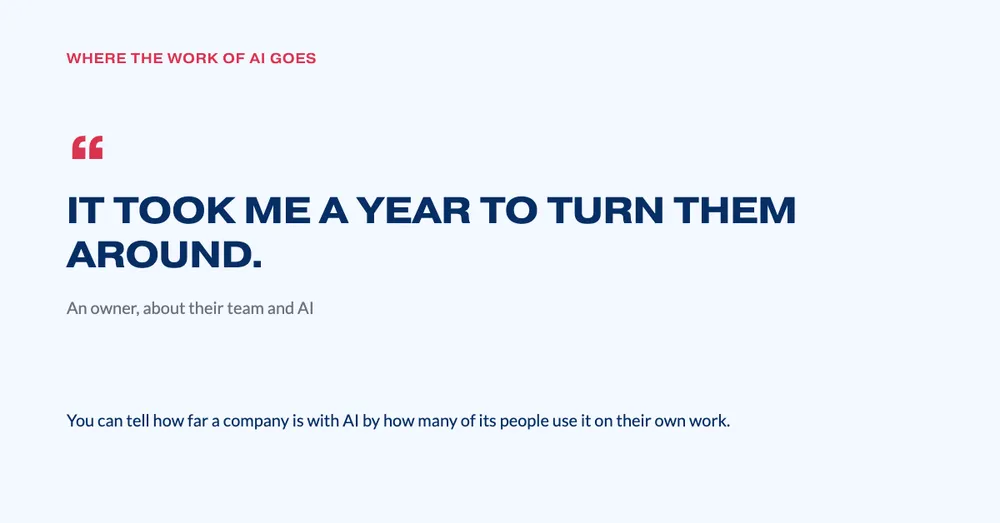
- "It took me a year to turn them around," one owner said about their team.
- Another, who expects AI to write 80 to 90% of their company's code by the end of the year, said software engineers aren't the most flexible people when it comes to this, and that getting them there is "a job" in itself.
- A third now first asks what has already been automated before signing off on a new vacancy.
The ones who are ahead spent their time getting their own people on board, much more than on choosing the right tools.
What makes AI pay off
The same EIB study also looked at what makes AI pay off more. Of everything companies invest in alongside AI, training their people raised the effect most, more than twice as much as software and data. Investment in reorganising processes had no measurable effect.
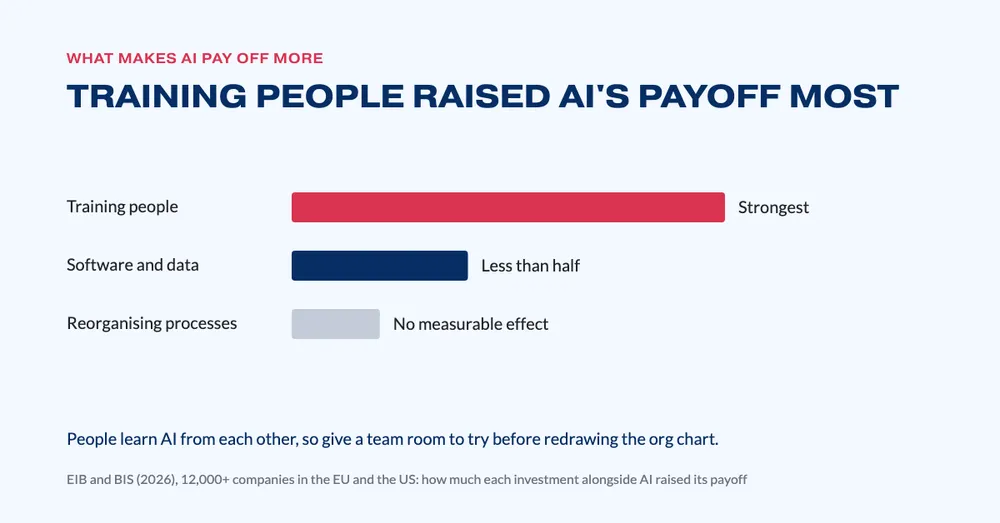
That matches how I think people learn to work with AI: from other people, on their own work. We have been rebuilding how we work with AI at Tunga for most of this year, and that is how it spreads here, from colleague to colleague. Last week one of our colleagues built a simpler workspace for working with AI agents, for colleagues who don't live in a code editor. And companies looking for a developer now ask us more often whether that person can bring this way of working into their team.
So if you run a company of 20 people and feel the big ones are running ahead with AI: they are. What decides whether you catch up is whether you give your people room to try AI on their own work, and to show each other what works.