My bet: word of mouth is going to matter more than ever, but only the part that's written down somewhere an AI can read it.
Last week my AI inbox assistant threw away 11 sales pitches. I didn't see a single one of them. That same week, our sales team reported that more and more of their calls to the UK are answered by an AI assistant first, which asks who is calling and why before it decides whether to put them through. And the list of PR agencies I'll be talking to in the coming weeks came from my AI too. The one PR agency that did reach me directly this month turned out to sell press release distribution, which is not what I was looking for.
So in one week I was both the buyer who filters everyone out and the seller who is being filtered out.
AI filters out cold calls and emails
For us that matters. Calling is how we find most of our new clients. In the Netherlands it works well. In the UK a growing share of our calls now ends with an assistant asking for a name and a reason.
But I don't think it's the biggest change. The filter only decides who gets through, while the choice of supplier is increasingly made before anyone calls.
AI decides who makes the shortlist
When I need a supplier, I ask my AI. I still use Google, but to check a fact, find an image or book a flight. For advice I go to the AI.
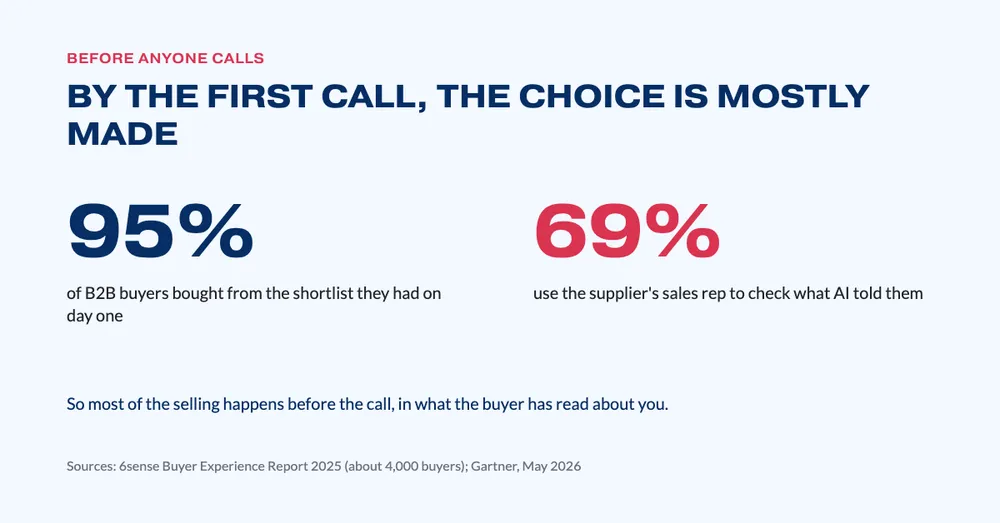
I'm not unusual in that. In G2's survey of 1,076 software buyers in March 2026, 51% said they now start their research in an AI chatbot more often than in a search engine, up from 29% a year earlier. By the time a buyer talks to anyone, the list is mostly set: in 6sense's 2025 survey of about 4,000 B2B buyers, 95% bought from the shortlist they had on day one. And in a Gartner survey published in May 2026, 69% of B2B buyers said they use the supplier's sales rep to check what AI told them.
The first conversation has become the place where the buyer checks what they already think.
So the question is how that shortlist gets made.
Search goods and experience goods
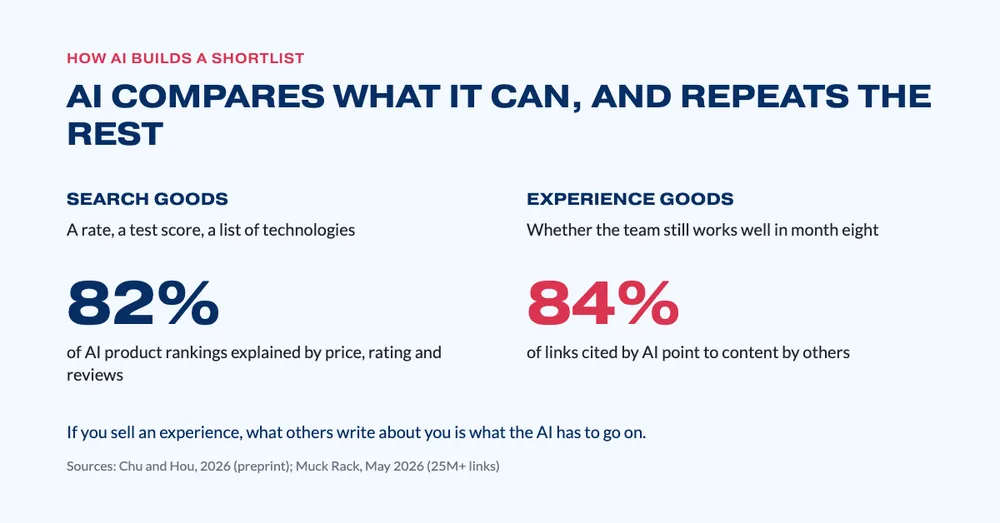
Economists have a useful distinction here. In 1970 Phillip Nelson separated search goods, which you can judge before you buy, from experience goods, which you can only judge afterwards. A rate, a test score, a list of technologies: search. Whether the team still works well in month eight: experience.
The AI handles the two differently. Where it can compare, it compares: in an experiment with product listings by Chu and Hou (2026, not yet peer reviewed), price, rating and reviews explained 82% of the differences in how three AI models ranked the products. Where it can't compare, it repeats what others have written. Muck Rack analysed more than 25 million links cited by AI tools and found that 84% pointed to earned media, such as journalism and other third-party content, rather than to the company's own material.
Large companies tend to buy outside talent as a search good, through procurement systems built for comparing rates and suppliers on paper. A boutique like ours is mostly experience. Our delivery and account management team has all been with us for at least 4 years, so clients deal with the same people for years. And this month the team is calling every developer who works at a client to check their internet connection and how they use AI, several of them on video to see the quality live. No comparison table shows that, and no AI sees it unless someone writes it down.
So AI favours two kinds of supplier: the ones that are easy to compare, and the ones others write about. A boutique can't win the comparison, so it depends on what others write.
Word of mouth has to be written down now
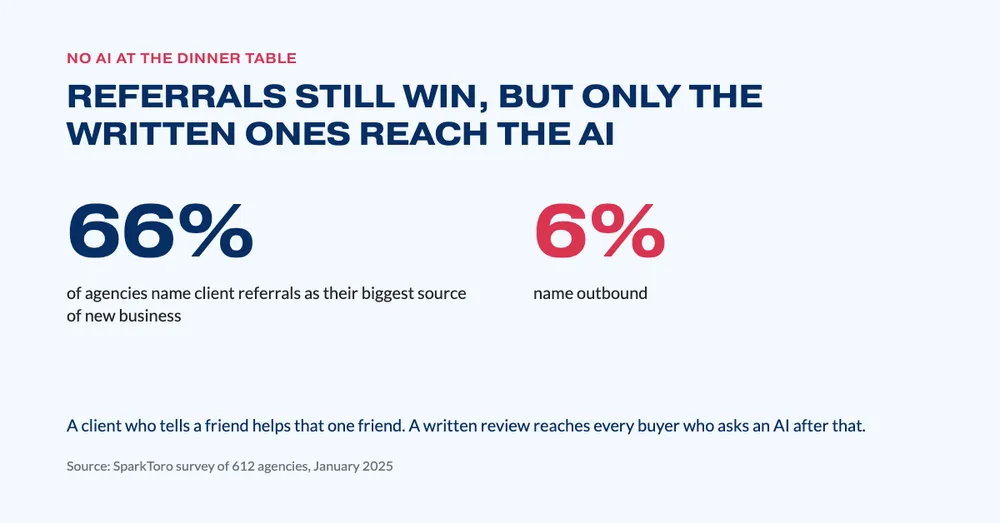
Referrals have always been how service businesses grow. In SparkToro's survey of 612 agencies, published in January 2025, 66% named client referrals as their biggest source of new business, against 6% for outbound.
But a referral used to travel over dinner, and there was no AI at the table. The client who tells a friend about you still helps that friend, but when the next buyer asks an AI for a shortlist, that conversation isn't in it. A review or a client story is the same word of mouth in written form, and that's the version that reaches the buyer who asks an AI.
What it means when you buy
It changed something for me as a buyer too. For important choices I ask more than one AI and compare the lists. They don't always agree, and the differences tell me how much of each list depends on what happened to be written down. The supplier that would suit me best might not be on any of them, simply because nobody wrote about it.
What we're doing about it
We're in the middle of making everything about Tunga readable for AI. It's a lot of work, and I think it's crucial. Part of it is our own content. The bigger part, if the numbers above are right, is what others write: asking clients for reviews on Clutch, telling more client stories, and keeping in touch when people we've worked with move to a new company.
If what you sell only becomes clear once people work with you, I expect your next new client to find you through something a previous client wrote about you.