For someone who runs a staffing company, I am bizarrely bad at hiring for my own. My default is to trust my gut and decide fast, because then at least it's done. As a result, I am surrounded with an amazing team, but I also regularly have to deal with my own mess. Right now I'm 3 months into cleaning up after a hire I made exactly that way. Major headache.
So it surprised me to read that hiring sits near the bottom of the average founder's stress list. In Sifted's survey of European founders this year, fundraising came first. Then the balance between the company and the rest of life. Then holding on to customers. Hiring landed among the things founders find least stressful.
I find that hard to believe. In the conversations I have with founders and CTOs every week, hiring is a core challenge. It just often shows up in a form you don't recognize as "hiring trouble".
Waiting too long to hire
Start with the vacancy that has been open for months.
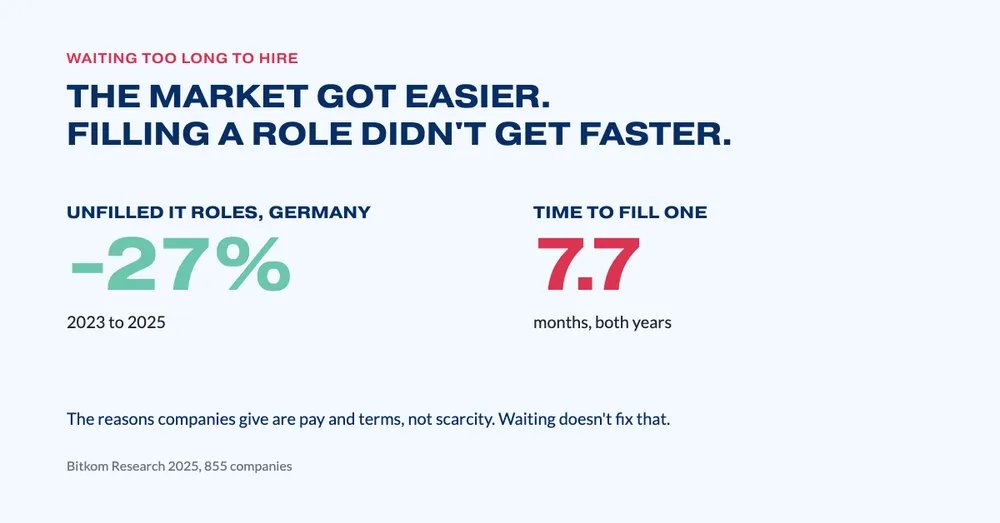
In Germany, filling an IT role takes 7.7 months on average, and that number hasn't moved since 2023, even though the market got easier: the count of unfilled IT positions fell by a quarter in the same period. So the time to fill doesn't drop when the shortage does. Vacancies stay open for a different reason: what the role asks and what it pays don't match, and that doesn't fix itself by waiting.
Meanwhile the open role costs time. In a startup under 25 people, a hire draws around 300 applications and 21 to 29 hours of interviewing, and the founder is often closely involved. Index Ventures, after studying 210 scaled companies, puts it plainly: founders underestimate how much time recruiting will take. Once a company grows past 10 people, it can eat up to a third (!) of the founder's week.
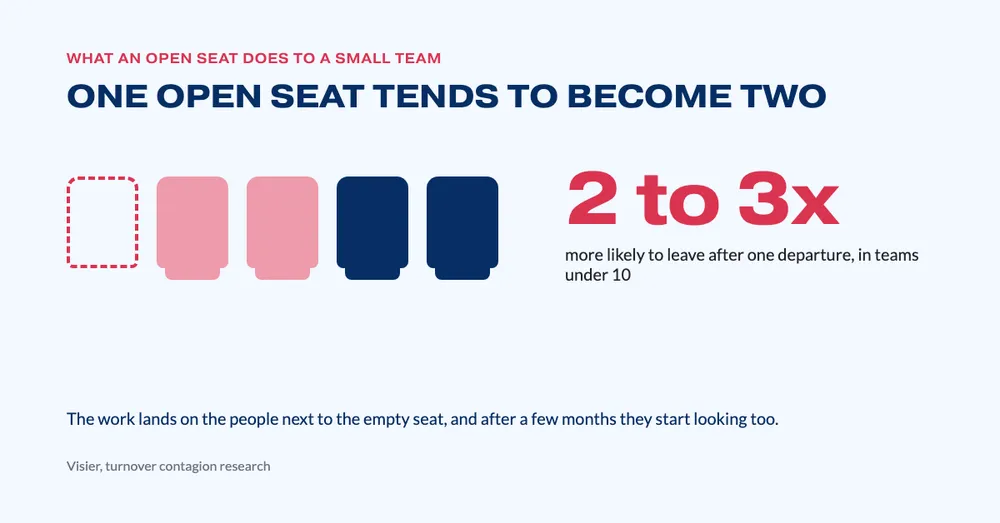
It affects the team too. In groups under 10, one departure makes the people who stay 2 to 3 times more likely to leave as well. So one open seat often turns into two.
And none of this gets called hiring. In practice it shows up as a delayed roadmap, or as an engineer who suddenly wants to move on.
Hiring too fast
The other way to cope is mine. Close it. Make a decision so I can focus on the work I actually enjoy doing. The kind that made me get into this in the first place.
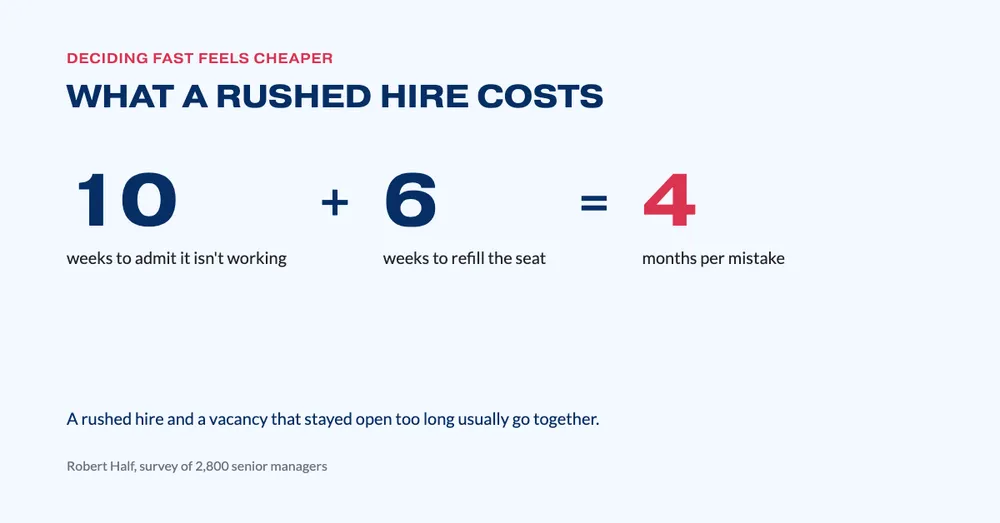
I'm in good company. In a survey of UK business leaders, nearly half said they had made a bad hire in the past 12 months. Asked what went wrong, the two biggest answers were settling for someone whose skills didn't quite match, and rushing the process. A US survey of 2,800 senior managers adds the timeline: on average it takes 10 weeks to admit the hire isn't working and 6 more weeks to refill the seat. 4 months per mistake. And more than half of the managers who made one say it led to more people leaving.
I'm fairly sure where the rushing comes from. Every week a vacancy sits open costs a bit of energy, and at some point deciding fast starts to feel cheaper than deciding well. In other words, the rushed hire is usually a consequence of the vacancy that stayed open too long.
And again, nobody calls this hiring. It's a bad quarter, or a manager spending a day a week on one person, or in my case 3 months of cleanup.
Why it doesn't feel like a hiring problem
With fundraising you know exactly what it costs you, because you know which weeks went into the deck and the pitch. With staffing you don't. The cost comes in later, as a delay, a resignation, a cleanup, or a decision you took too fast to be rid of it, and by then you're calling it something else.
There's research on this. Psychologists call it "attention residue": when you leave a task unfinished and move on, part of your attention stays with it. An open vacancy is exactly that, for months, with a reminder every week. It runs in the background, and things that run in the background don't make it onto anyone's top 3.
You see the same thing in public discourse. We looked at a year of posts on X by founders and CTOs in the Netherlands, the UK, Germany and the Nordics, and nobody describes what a long-open engineering role cost them personally. They talk about the market, the salaries, the CVs: the part they can see. The cost of hiring struggles is real, it just doesn't get booked as hiring, so nobody adds it up.
When it does become visible
At Tunga we see it at the one moment it does become visible: when it stops.
I once asked a client why she chose to work with us. Her answer: "Because with you, I can trust things are properly taken care of." This is not to pat ourselves on the back, but it illustrates that what clients tell us after a placement is mostly relief that the whole thing is off their plate. It shows in our numbers too: 4 out of 5 searches existing clients bring us end in a placement.
And in case you're wondering how a staffing company run by someone this bad at hiring gets away with it: I don't do the hiring for our clients myself. We have a team for whom this is the core of their work, and honestly the reason they get out of bed in the morning. The work isn't beneath anyone. It just ends up in the wrong place when it lands on my desk.