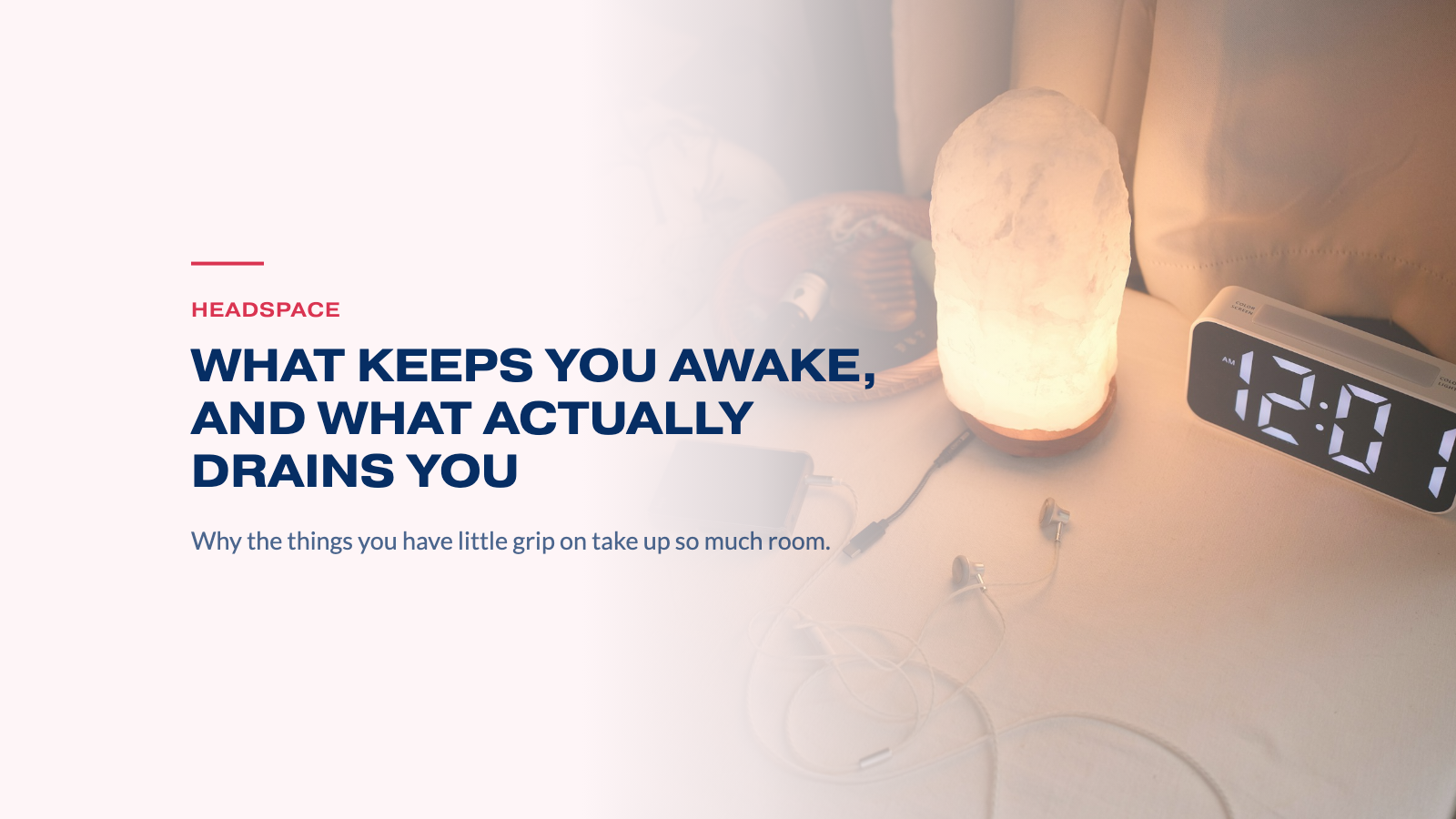
Ask entrepreneurs in a survey what keeps them awake at night, and you get a familiar list. Talk to them, and one word keeps coming up that isn't on it: headspace.
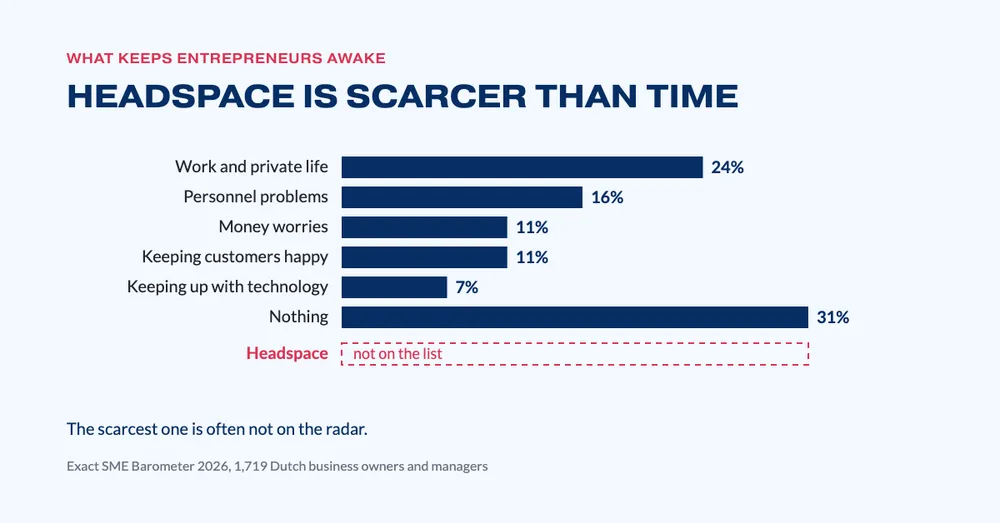
The list comes from the Exact SME Barometer, which put the question to 1,719 Dutch business owners and managers earlier this year:
- the balance between work and private life: 24%
- personnel problems: 16%
- money worries: 11%
- keeping customers happy: 11%
- keeping up with technology: 7%
- nothing: 31%
We talk to hundreds of entrepreneurs every month, and that word comes up a lot, often in English even when the rest of the conversation is in Dutch. "The honest answer is that I don't have the headspace for it right now," one of them said. Another: "if I do something like that, I want to have enough headspace for it."
It made me realize: headspace is the scarcest thing an entrepreneur has.
Money, people and the rest of life
Some of what takes up headspace is exactly what you'd expect, and you hear it in the conversations too.
- Money. One founder described "artificially keeping our head above water, month by month".
- Work and private life. Hardly anyone named it as a worry, but it showed everywhere: people picked up on holiday, at the gym, with the kids around, and once from a hospital bed.
- People. Interestingly, few people said hiring was hard. What came up was everything after it. "It's not about developers, it's about communication," one owner said. Another explained that onboarding external people takes so long that "there's very little to gain".
These are the drains founders know by name, and the survey picks them up.
Small things that take up a lot of headspace
Some things take little time or money and still take up a lot of room in your head. When I studied sociotechnics at university, I learned why: stress doesn't come from too much pressure as such, but from too much pressure combined with too little control capacity. In Dutch we call it "regelcapaciteit": the room you have to do something about what's happening.
Three examples from those conversations:
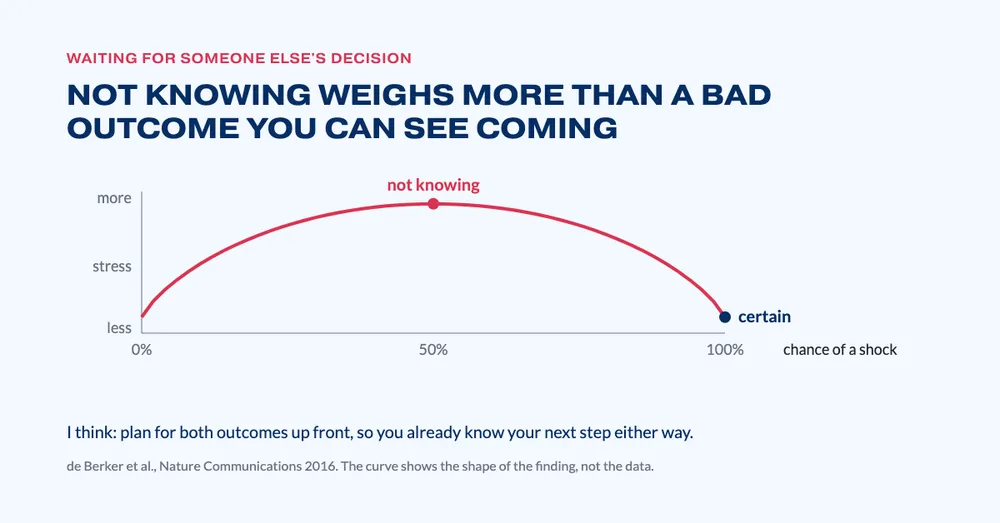
- Waiting for a decision someone else makes. A funding round, a decision at group level, a client who hasn't signed. In an experiment by neuroscientist Archy de Berker and colleagues (2016), people were most stressed when the chance of an electric shock was 50%, more than when the shock was certain. Not knowing weighs more than a bad outcome you can see coming.
- Depending on one person. One owner told us their app runs on an old stack maintained by a single freelancer, "the same age as me", who is about to stop. That takes 0 hours a week, until the day it takes all of them.
- Things outside your own expertise. One company told us: "we're struggling with our own software engineering". A new security regulation nobody quite understands. Being able to use your own skills is part of control, and that is exactly what you lose when the problem is outside your field, however much authority you have.
That last point may also explain why a meta-analysis of 94 studies (Stephan, Rauch and Hatak, 2023) found that entrepreneurs are more satisfied with their work than employees, but not less stressed. My reading: we have more freedom than almost anyone, and freedom doesn't help with the specific things we have no grip on.
What eats headspace is the things you have little grip on, whatever their size.
Building in control capacity
Running a business comes with pressure, and most of us chose it. What you can change is how much grip you have.
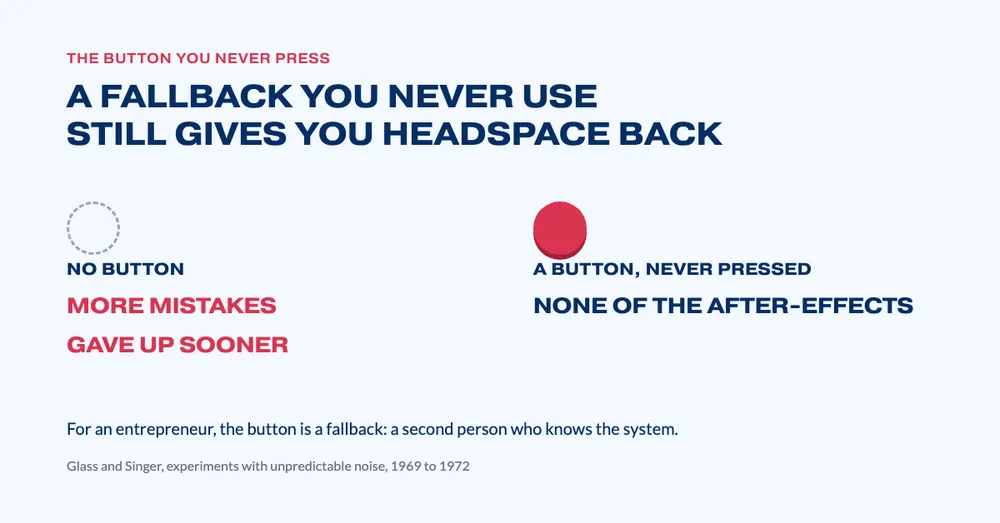
In experiments from the late 1960s and early 1970s, the psychologists David Glass and Jerome Singer exposed people to unpredictable noise. One group had a button that could stop the noise, but was asked not to use it. That group showed none of the after-effects the others had, such as making more mistakes and giving up sooner on difficult puzzles, even though nobody in it ever pressed the button.
For an entrepreneur, that button is a fallback: a second person who knows the system, a plan for both outcomes of the decision you're waiting for, someone to call when the new regulation lands on your desk.
For the things outside your expertise, that fallback is other people. Building in control capacity there means gathering people around you whose trade it is: colleagues, co-founders, partners, suppliers.
When something keeps taking more headspace than it deserves, I now ask two questions: where is my grip on this, and whose trade is it?