We track 1000s of software developer job postings daily across Northern Europe and North America at Tunga. And we talk to the CTOs and founders posting them. Many of those job postings describe an impossible person. A "Senior ML Engineer" position posted in January 2026 requires
We track thousands of software developer job postings daily across Northern Europe and North America at Tunga. Many of those job postings describe an impossible person. A 'Senior ML Engineer' position posted in January 2026 requires '5+ years experience with LLM fine-tuning and RAG architecture.' But LLM fine-tuning entered mainstream practice in 2023. And RAG architecture achieved production adoption only in 2024. The mathematics don't work.
This isn't someone being unreasonable. It's someone who knows the world is changing rapidly but doesn't have time to fully grasp how. So they list everything they think they might need, just to be safe.
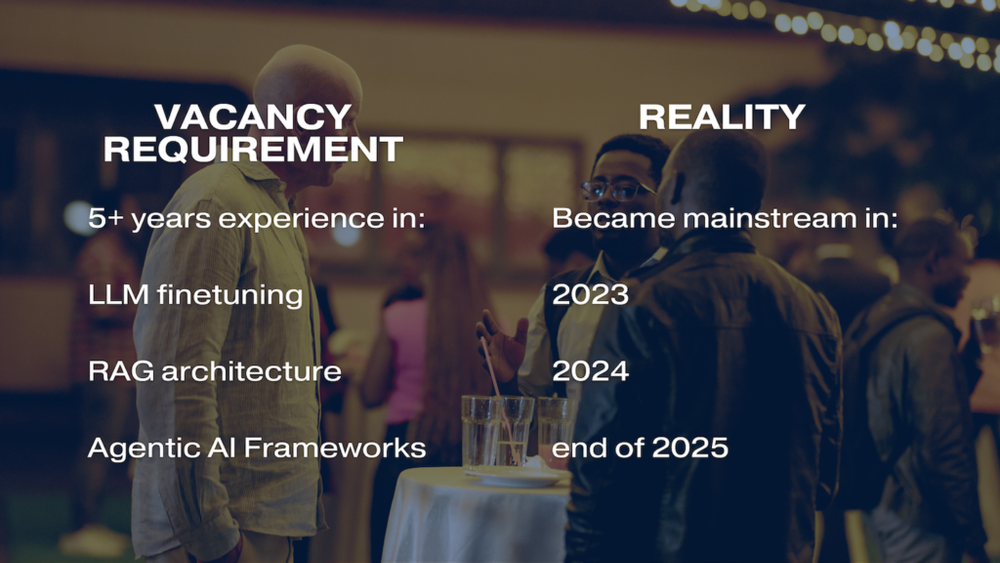
Job descriptions in 2025 are 30-40% longer than equivalent roles in 2023, almost entirely from more granular technical requirements. According to IBM, 99% of developers are still 'exploring' AI agent development. Yet postings increasingly demand 'experience with agentic AI frameworks.' The agentic coding market is projected to grow from $7.8 billion in 2025 to $52.6 billion by 2030. What we're seeing isn't a description of the current market. It's anxiety about the future, expressed as present-tense requirements.
The Seniority Paradox
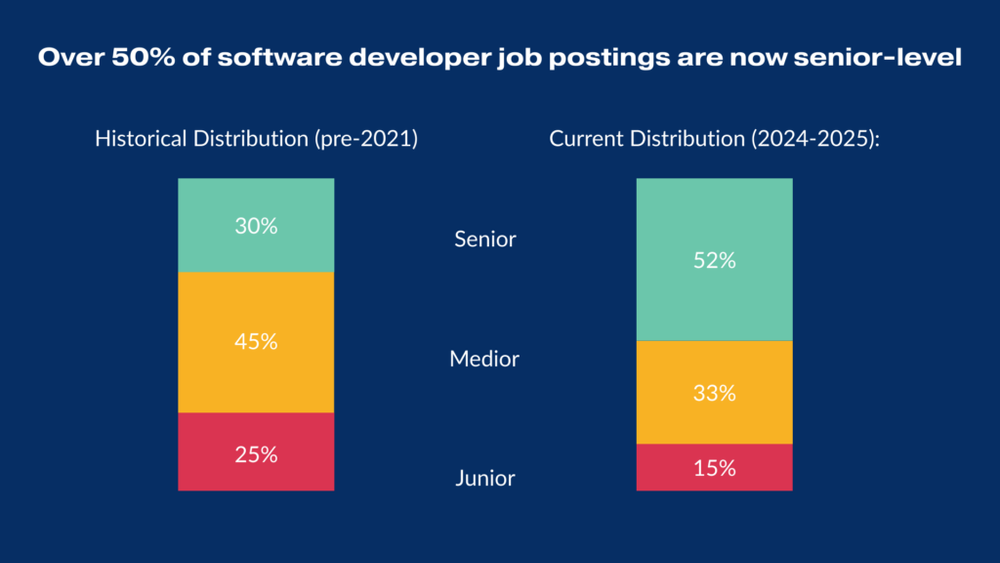
Over 50% of software developer postings are now senior-level, compared to 30% historically. During the same period, entry-level postings increased 47% from their 2023 lows. Both ends are growing simultaneously. 89% of 'senior' postings require 7-10+ years experience, but 76% require experience with technologies less than five years old. Companies are designating roles as 'senior' partly to signal they're willing to pay competitively and filter for people who won't need hand-holding.
What Leadership Doesn't Know Yet About AI
When we talk to company leadership about agentic AI, there's a consistent pattern. They know it should be an opportunity to produce code at scale. They know their competitors are exploring it. But they struggle to fully grasp how it works in practice. So they add 'experience with AI agents' to the posting and hope candidates will figure it out.
The disconnect: top candidates leave the market within 10 days of active job search, but average time-to-fill is 44 days globally. If the best candidates commit in 10 days but your process takes 44, you never meet them. The constraint isn't talent scarcity — it's that by the time companies move through their process, qualified candidates have already accepted other offers.
What Companies Say Versus What They Screen For
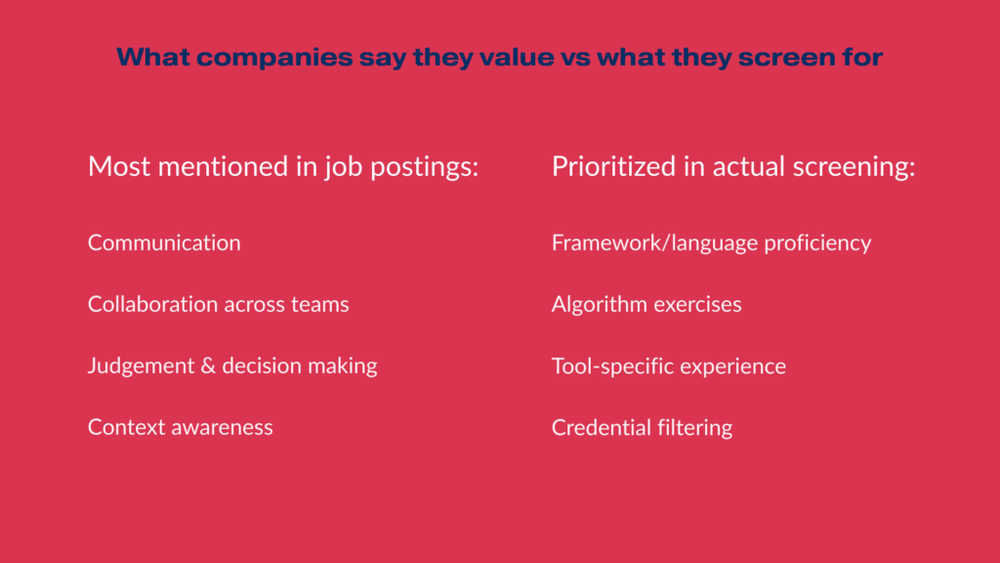
Communication ranks as the most frequently mentioned skill across nearly 2 million tech job postings — more than Python, JavaScript, or any framework. Yet most processes screen exclusively on technical qualifications in early stages. Soft skills get evaluated in final rounds, if at all.
What Actually Works
The companies successfully hiring do a few things differently: they separate core from aspirational requirements; they optimize for process speed since top candidates move in 10 days; they screen for what actually predicts success (if communication matters, evaluate it early); and they reconsider where they look.
We work with senior developers in Africa who have 8 years building distributed systems, strong communication developed working with international clients, and are learning agentic AI right now like everyone else. They sometimes get screened out of European and US processes for lacking specific credentials or local experience, while companies complain about talent shortages. When everyone is learning agentic AI simultaneously, architecture skills, communication ability, and learning velocity become primary.
What This Means for Developers
Soft skills now predict success more strongly than framework mastery. When 73% of backend postings mention 'AI collaboration experience,' they're asking whether you can work effectively in an environment where AI handles implementation while humans handle judgment and strategy. Tool expertise has a shorter half-life than ever — specialize in durable layers (distributed systems, resilient data pipelines) rather than transient tools. Geographic barriers are narrowing: the 'you're not from here' disadvantage has narrowed substantially because barriers like local tool experience matter less when everyone learns the same new tools simultaneously.