None of them said they no longer need developers. They just need different ones. What CTOs, founders and engineering leads at ten Tunga clients told us about building, staffing and hiring in the age of AI.
During one of these interviews, a client turned the conversation around and asked us a question of his own. If development shifts to AI, how does a company like Tunga, built on placing developers, stay relevant?
It's a fair question, and not a comfortable one. It's also the reason we started these conversations in the first place. Over three months, we spoke with CTOs, heads of engineering, founders and technology leads at ten of our clients, from a small fintech company to an international NGO. We wanted to hear how AI is changing the way they build, staff and hire, in their own teams and this year.
Every one of them still needs developers. Almost everything about what they need from those developers is changing.
Key takeaways
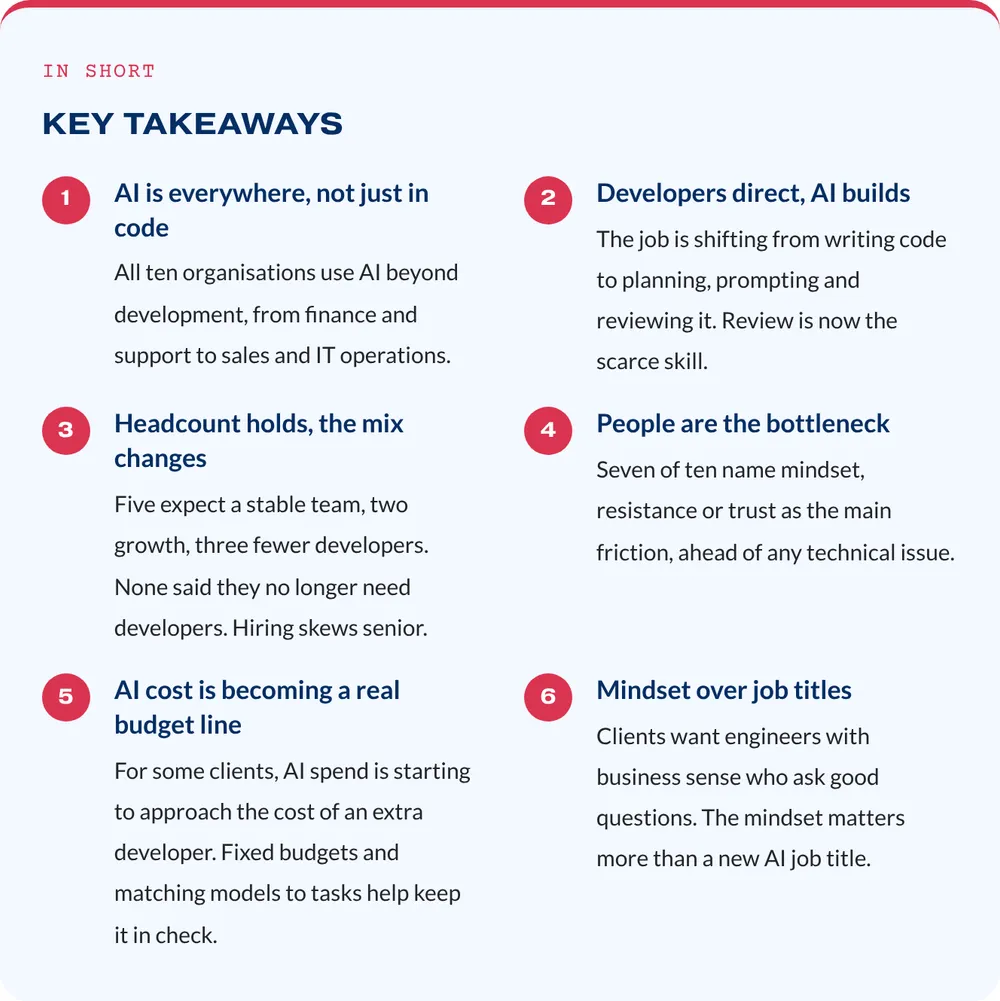
- AI is everywhere, not just in code. All ten organisations use AI beyond development, from finance and support to sales and IT operations.
- Developers direct, AI builds. The job is shifting from writing code to planning, prompting and reviewing it. Review is now the scarce skill.
- Headcount holds, the mix changes. Five expect a stable team, two growth, three fewer developers. None said they no longer need developers. Hiring skews senior.
- People are the bottleneck. Seven of ten name mindset, resistance or trust as the main friction, ahead of any technical issue.
- AI cost is becoming a real budget line. For some clients, AI spend is starting to approach the cost of an extra developer. Fixed budgets and matching models to tasks help keep it in check.
- Mindset over job titles. Clients want engineers with business sense who ask good questions. The mindset matters more than a new AI job title.
Who we spoke to
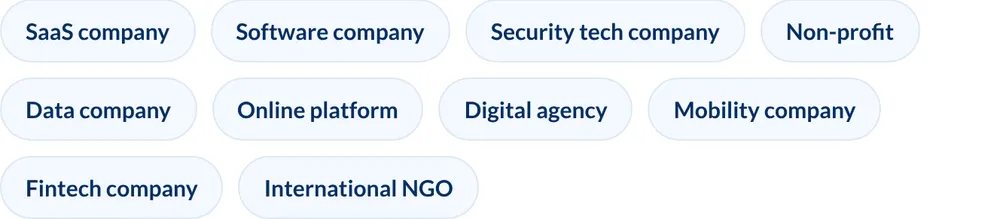
All ten are Tunga clients, and we promised to keep their answers anonymous. That's why you'll see labels like "SaaS company" instead of names: a SaaS company, a software company, a security tech company, a non-profit, a data company, an online platform, a digital agency, a mobility company, a fintech company and an international NGO.
AI has left the code editor
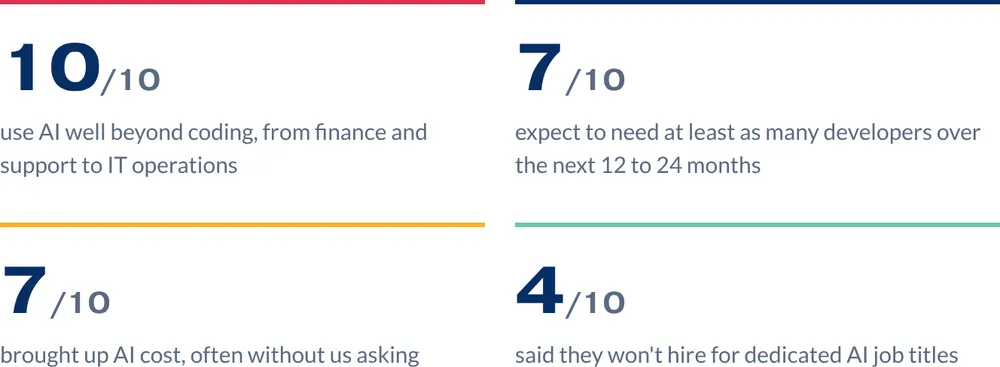
Ask a technology leader where AI shows up and you'd expect them to start with code. Almost nobody did. At one data company, it's hard to find a part of the business AI hasn't touched, and the fintech company told us much the same. Development is still the most mature area everywhere, but support, finance, sales, HR and infrastructure are catching up fast. Six of the ten also build AI into the product they sell.
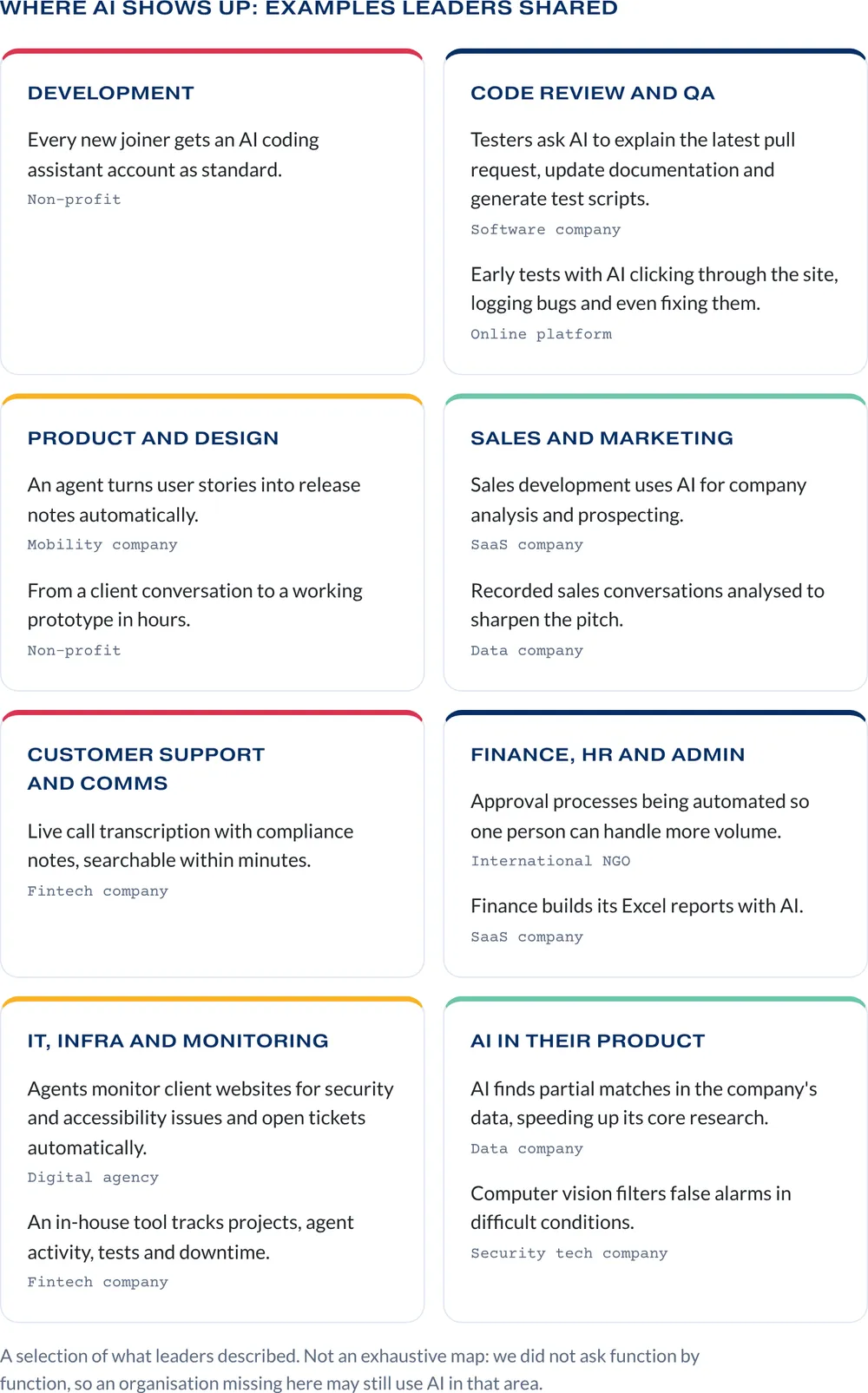
What differs is depth. At one software company, owned by a private equity group with an "AI first" rule, some colleagues still use AI as a smarter Google search while others have automated entire workflows. The online platform saw usage shoot up like a hockey stick within three months of a company-wide rollout. And at the security tech company, AI has been part of the product for years and AI training is mandatory for everyone.
The developer becomes an orchestrator
One shift came up in every single conversation. Developers write less code themselves and spend more time planning, prompting, steering agents and reviewing what comes back. To get a sense of how far each team has come, we placed their development workflow on a simple four-step ladder. Nobody is still exploring. Half have made AI a team standard, and two already run much of their development through agents.
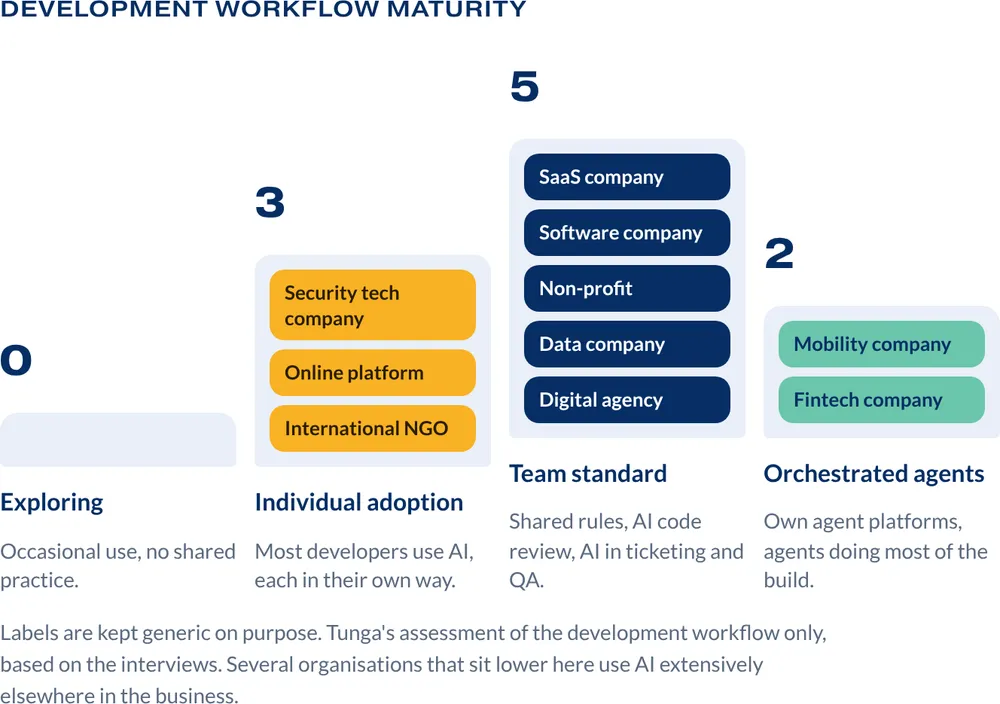
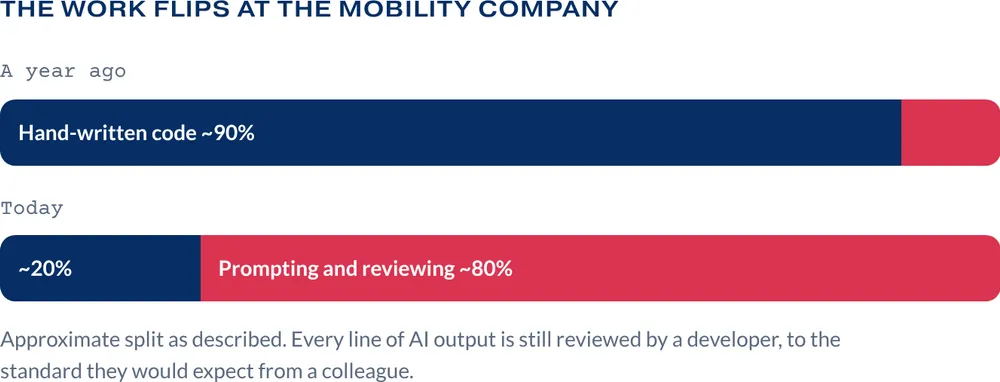
At the top of that ladder, the mobility company's development team now runs close to 100 agents for its own processes. Within a year, the share of code its developers write by hand has flipped: a year ago roughly 90% was hand-written, today it is about 20%, with around 80% of the work spent prompting and reviewing. Every line of AI output is still reviewed by a developer, to the standard they would expect from a colleague.
Across the group, a few practices are becoming normal. Pull requests get reviewed by AI and by a colleague. Tickets arrive better scoped, because AI has already looked through the codebase. Several leaders are now working towards parallel work, where developers start several agent sessions in the morning and review the output during the day. One SaaS leader warned that this only works if you can plan tasks big enough to keep an agent busy for an hour or more, and most teams are still learning how.
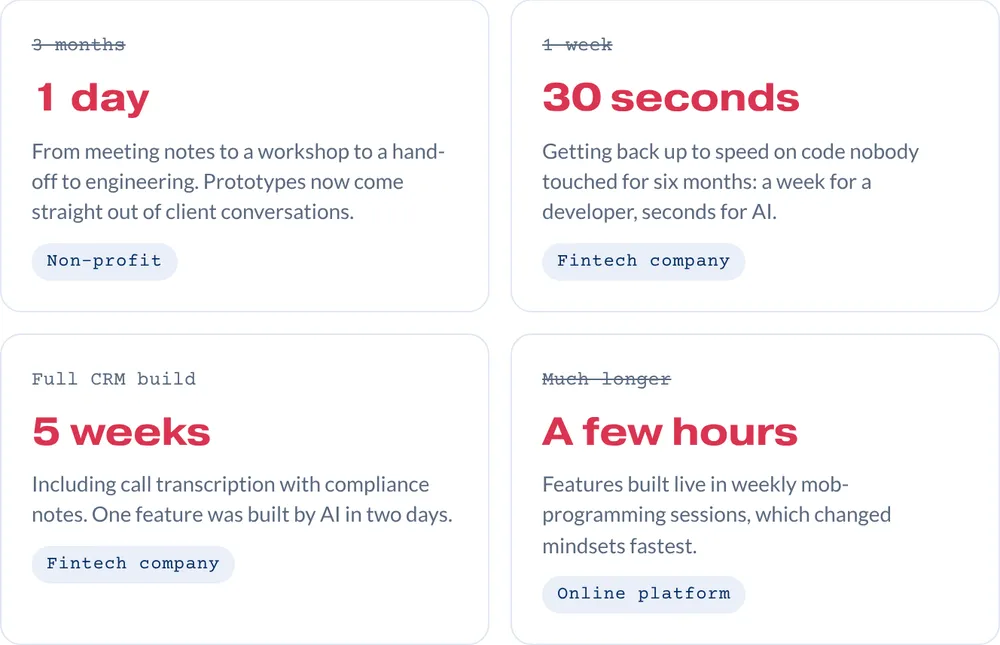
Not everyone sees a team-wide shift yet. An engineering leader at the online platform told us AI has changed how individuals work, but not yet how teams build software. He sees a group of front-runners shipping mostly AI-written code, a middle group dipping their toes in, and people who are holding back. The bigger change, he thinks, will come once product, design and engineering share code, decisions and reasoning in a way AI can fully access.
Same teams, different people
Given all this, you might expect teams to be shrinking. Most aren't. Looking 12 to 24 months ahead, five leaders expect a stable team, two expect some growth and three expect to need fewer developers.
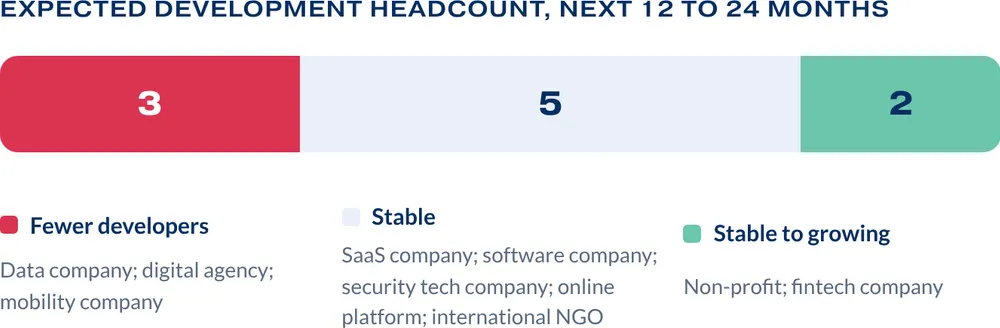
The leaders with stable teams all gave a version of the same reason. The backlog is never empty. One software leader admitted that six months ago it might have predicted fewer developers, but in practice the same people now build bigger and more complex things. The three expecting fewer developers had specific reasons. The digital agency closed its open vacancies. At the mobility company, the work moved from development to design and product ownership, where AI hasn't taken over yet.
What changes almost everywhere is the mix. Hiring is moving towards seniors, because reviewing AI output well takes experience. The online platform has put junior and mid-level hiring on hold for the next year or two. The mobility company deliberately does the opposite and keeps room for juniors, because an industry that stops training new people will feel it in a few years.
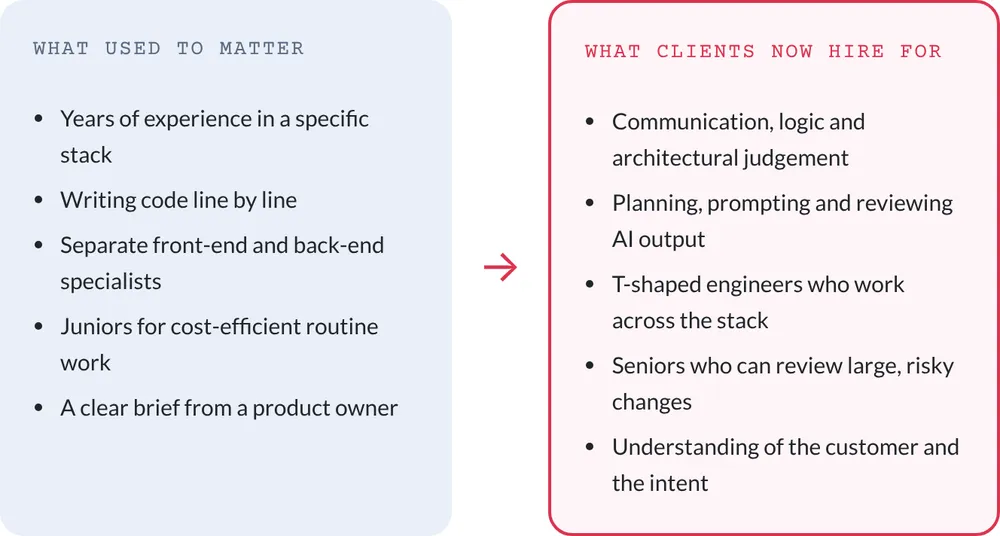
Job interviews are changing too. One SaaS company lets candidates use AI in their assignments and then checks whether they understand what they handed in. The non-profit gave us a rule of thumb we keep coming back to. Working with AI should be about a quarter of a developer's ability, and it only works if the other three quarters are there. If AI tools went dark tomorrow, could your engineers still build?
The hard part is people
When we asked where AI creates the most friction, we expected to hear about tools and integrations. Instead, seven of the ten talked about people: mindset, resistance and trust.
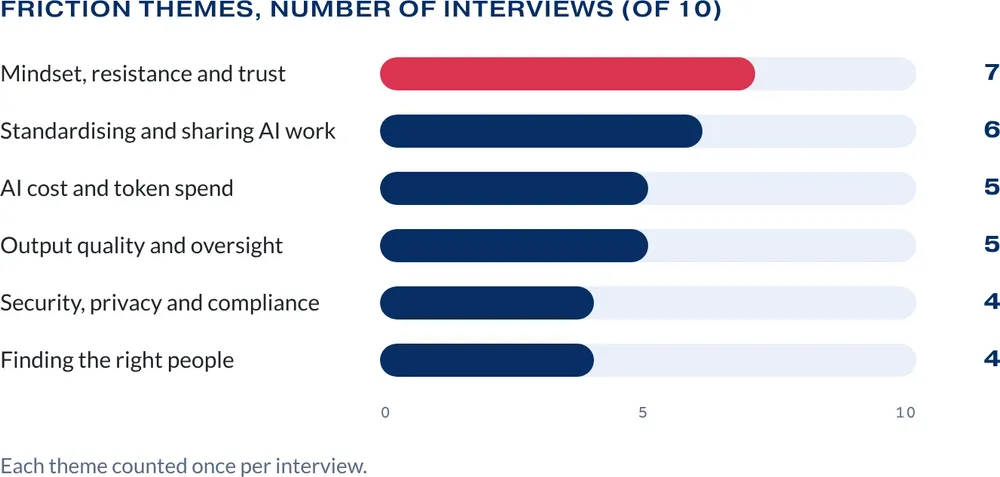
That resistance shows up in different places. At the digital agency, the seniors held out longest. They love writing code, and handing it to AI felt like giving away the best part of the job. It took about a year before they came round. The international NGO described how the same AI-prepared document was called "perfect" by one colleague and dismissed as "another AI thing" by the next.
The second theme is standardisation. Plenty of people use AI, but what they produce often stays with them, so the knowledge leaves when they do. Oversight is another worry. One data company has seen AI-driven tickets quietly grow beyond what was asked, until they were too big to review with confidence. The same leader is also thinking about motivation, since most developers enjoy building more than reviewing.
The organisations that move fastest have a few things in common. There is a clear champion, someone who owns adoption, and time set aside to learn together. At the online platform, a team lead builds a feature live with AI in a weekly mob-programming session. According to the team, nothing has done more to change minds.
Calm helps too. One leader spent part of our call dealing with a live security vulnerability in the background, and still talked through his AI plans without a hint of panic. Awareness, not alarm, is how he described his approach.
The cost question nobody budgeted for
Cost wasn't on our list of questions. It came up anyway, in seven of the ten conversations, and one leader suggested we ask every client about it from now on. Some told us AI saves far more than it costs. Others are worried about what happens when today's prices go up.
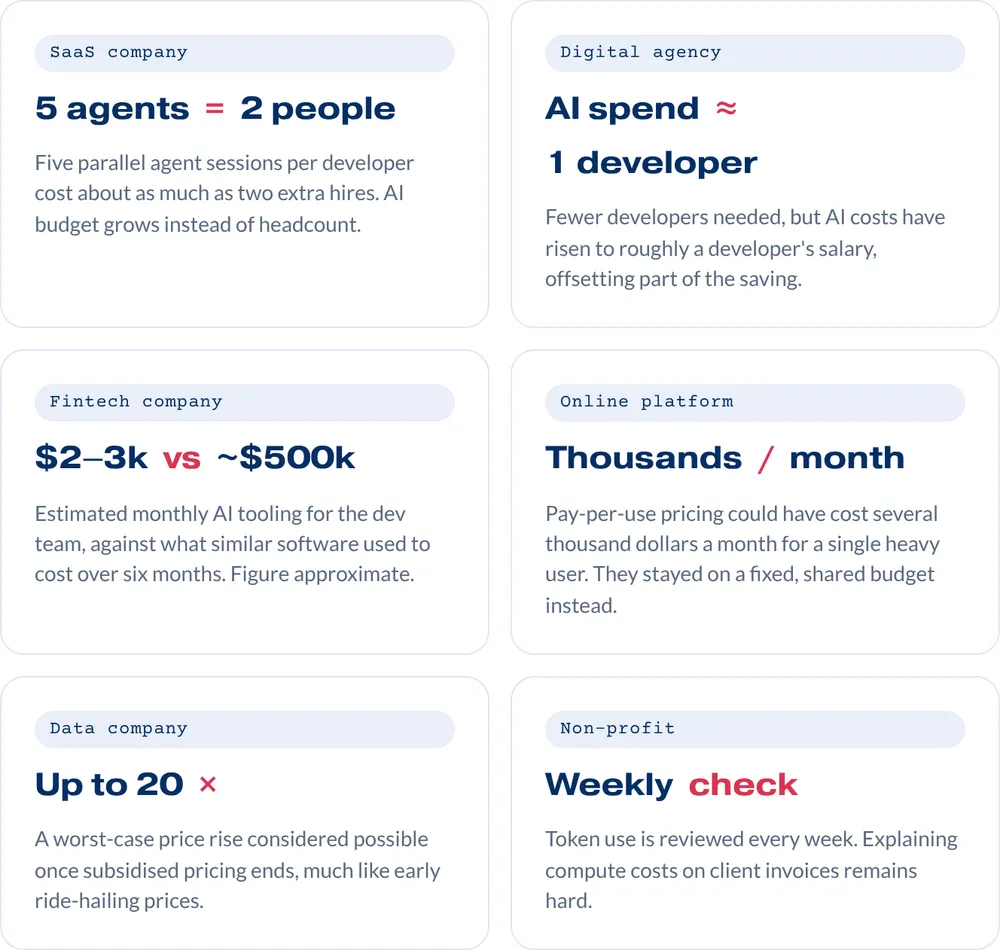
The leaders who feel in control of cost do three things. They set a fixed AI budget per team, check usage every week, and use lighter models for simple work instead of the most powerful model for everything. That last habit alone can make a difference of several times in cost. One security tech leader summed up the underlying question well. If AI costs as much as hiring someone, it needs to deliver clearly more than that person would.
Hybrids, not job titles
We expected clients to talk about new AI job titles, such as AI operators or automation specialists. Hardly anyone framed it that way. Four said they won't create dedicated AI roles at all. What they talked about was a way of thinking.
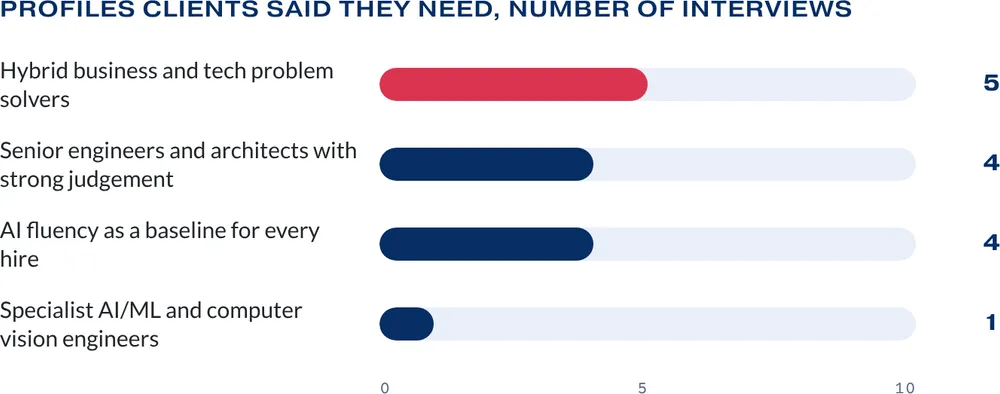
The non-profit expects one profile to matter most, the forward deployed engineer. That's someone with product sense and engineering skill who can sit in a client meeting and turn what they hear into a working first version on the spot. One data company found that technical depth alone isn't enough. Its AI specialist knew the technology inside out but struggled to see where it could help the business. The online platform sees senior, principal and architect roles becoming much more valuable. And the founder of the fintech company summed it up in one sentence.
Where the industries are heading
We closed each conversation by asking where AI is taking their industry in the next year or two.
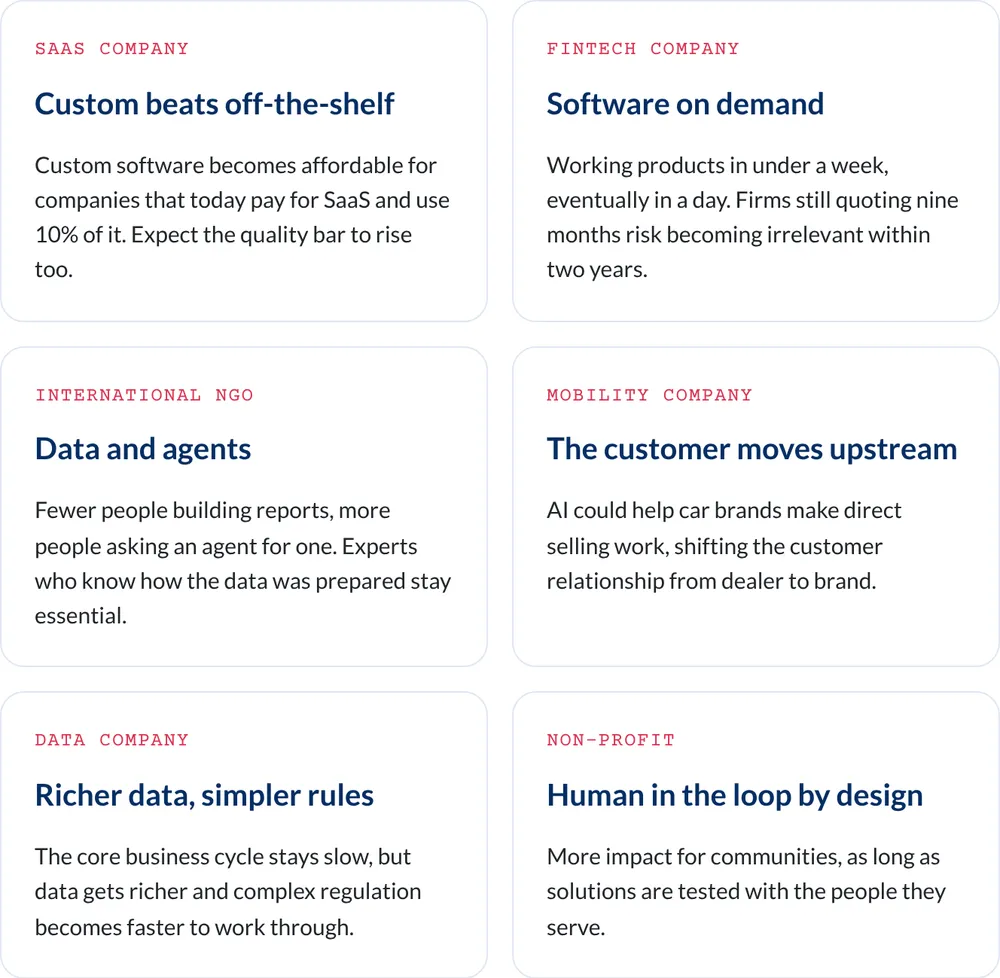
Another leader added some healthy realism. Nobody, they said, can plan credibly beyond 18 months. Their roadmap is written in pen for the first 18 months and in pencil after that.
Six moves worth making
Looking across all ten conversations, the organisations furthest ahead tend to do the same six things.
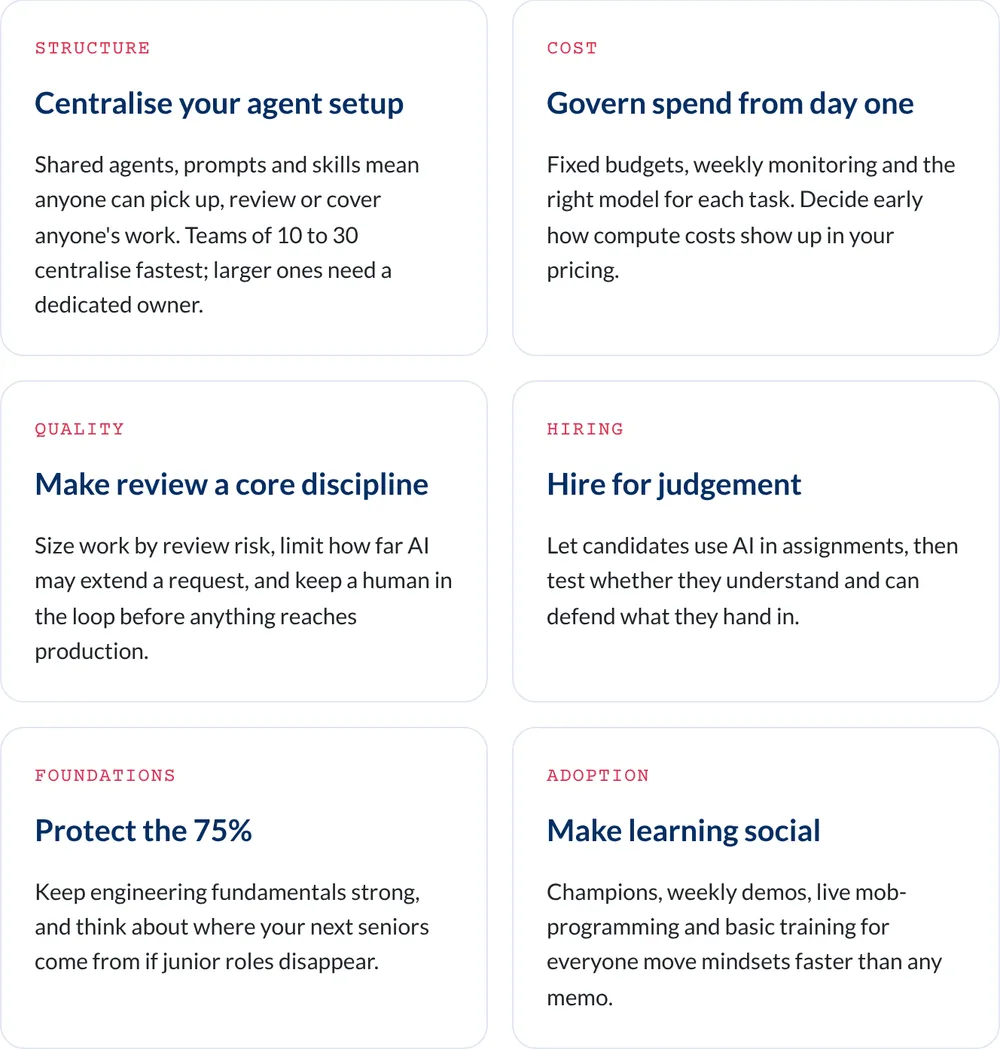
- Centralise your agent setup (structure). Shared agents, prompts and skills mean anyone can pick up, review or cover anyone's work. Teams of 10 to 30 centralise fastest; larger ones need a dedicated owner.
- Govern spend from day one (cost). Fixed budgets, weekly monitoring and the right model for each task. Decide early how compute costs show up in your pricing.
- Make review a core discipline (quality). Size work by review risk, limit how far AI may extend a request, and keep a human in the loop before anything reaches production.
- Hire for judgement (hiring). Let candidates use AI in assignments, then test whether they understand and can defend what they hand in.
- Protect the 75% (foundations). Keep engineering fundamentals strong, and think about where your next seniors come from if junior roles disappear.
- Make learning social (adoption). Champions, weekly demos, live mob-programming and basic training for everyone move mindsets faster than any memo.
Back to that question
We opened with a client asking how a company like Tunga stays relevant if development shifts to AI. After ten conversations, our answer is that the need for developers hasn't gone away, but the work around them has changed. For clients, three things stand out.
Prototypes are cheap, production is not. Building has never been easier. With tools like Lovable, anyone can create a working prototype in hours, and clients see non-technical colleagues starting to build things themselves. The cost shows up later, when that prototype needs to be secured, maintained, scaled or rebuilt. We recently spoke to a company that built its product with AI and then needed around three weeks of developer work to make it ready for production.
The interviews point the same way. The non-profit expects platform architects to become more important as AI-built apps multiply, because someone has to separate what is stable and secure from what only looks good. The online platform expects to need more DevOps capacity as more people outside engineering start building. The hidden cost of AI-built software is the expertise it takes to make it last.
How we vet developers is changing. Next to the fundamentals, we now look at how developers prompt, review and push back on AI. One recent client interviewed candidates almost entirely on how they work with AI, instead of years in a specific stack, and found the right people faster.
Someone has to grow tomorrow's seniors. If junior hiring slows down across the market, the pipeline of future reviewers and architects dries up. We see developing that talent as part of our role, with the fundamentals first. Roughly half of learning should still happen away from the screen, so developers understand what AI is actually doing.
Thank you to everyone who made time for these conversations. Many of you ended with the same question for us: how are others dealing with this? We hope this piece answers part of that. We're happy to compare notes on centralising AI setups, managing cost or building teams that work well with AI. Curious to hear your thoughts.
Compare notes with Tunga
Centralising AI setups, managing cost or building teams that work well with AI: we're happy to share what we're seeing. Or write to [email protected].
Talk to TungaHow we did this research
Ten semi-structured interviews of around 40 minutes, held over a period of three months in 2026 with technology leaders at Tunga clients. Every conversation followed the same five question blocks. In an environment that changes this quickly, three months is already a limitation: some participants may well work differently by the end of the research cycle than when we spoke to them. We coded each interview by theme; counts show in how many conversations a theme came up and describe this group, not a statistical sample. Some recordings were partial and a few figures were given as estimates. All participants are anonymised.
By Bart Leijssenaar, CCO at Tunga, and Virtuous Fanny, Talent Manager at Tunga. November 2026.